
Your crystals & rocks collection. Your way.
Crystals & Rocks Collection Management
Start with the items you own and record the details useful to you.
Keep things simple, or go deeper with species, locality, mine or source, crystal habit, matrix, associated minerals, dimensions and weight whenever they matter.
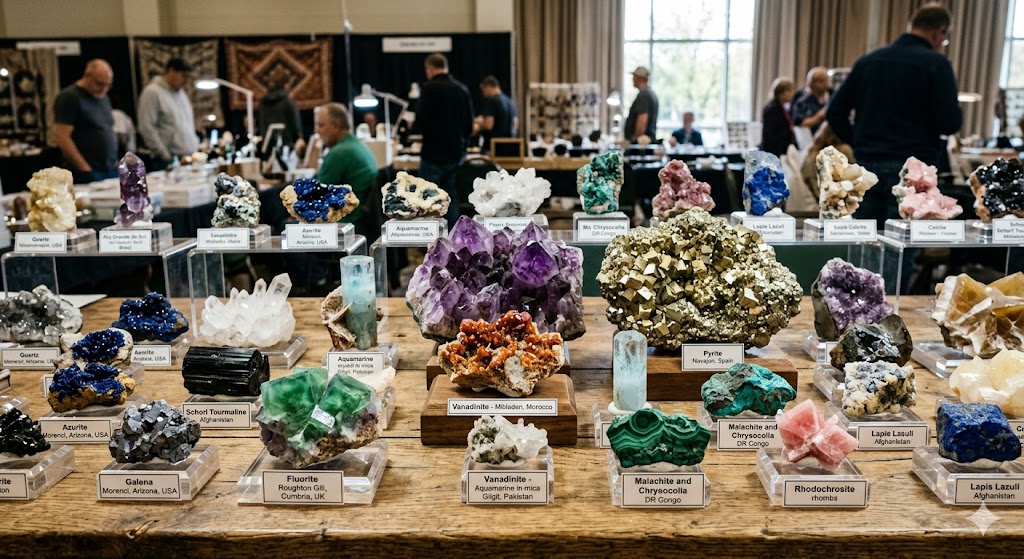
Collect at your own depth
A useful crystal and rock record can be simple or highly detailed.
One item might need little more than a name, photograph and condition. Another might deserve detailed records of species, locality, mine or source, crystal habit, matrix, associated minerals, dimensions and weight. Both belong in Collectaneum.
Start quickly. Add detail when it earns its place.
Why the collection becomes difficult
The specimen and its locality tell one connected story
Two visually similar specimens may represent different species, varieties or formation environments. Equally, specimens of the same mineral can have very different collecting importance because of locality, mine, crystal habit or historical labels.
Natural specimens also change physically. Chips, repairs, coatings, unstable minerals and light-sensitive colour require condition observations that belong to the exact specimen.
Species and variety
Separate mineral species, variety names and trade names so identification remains precise and reviewable.
Locality and source
Preserve country, region, mine, quarry, geological formation or collecting site at the level the evidence supports.
Habit and matrix
Record crystal form, aggregate, matrix, associated minerals and relationships visible in the specimen.
Measurements and scale
Keep dimensions, weight and scale photographs with the owned specimen rather than relying on appearance.
Labels and provenance
Preserve old collection labels, dealer information, field notes, previous ownership and acquisition history.
Condition and stability
Record chips, repairs, coatings, friability, light sensitivity and other handling or storage concerns.
From mineral identity to owned specimen
Build the record in connected layers
Shared mineral knowledge can describe a species or locality, while dimensions, labels, condition, provenance and photographs remain specific to the specimen in hand.
Identify the material
Record mineral species, variety, rock type, chemical or classification information and confidence in the identification.
Locate the specimen
Capture country, region, locality, mine, quarry, formation, collector or source information at an evidence-based level.
Describe your example
Preserve habit, matrix, associated minerals, dimensions, weight, condition, repairs, display method and storage location.
Attach the evidence
Connect labels, field notes, receipts, provenance, research references, photographs and valuation records.
A record in practice
A fluorite specimen is more than the word fluorite
The shared record may identify fluorite as the mineral species and preserve recognised variety or classification information.
The owned specimen record then captures locality or mine, crystal habit, colour, matrix, associated minerals, dimensions, weight, chips or repairs, old labels, acquisition source, photographs and storage requirements.
A second fluorite specimen can share mineral knowledge while remaining a distinct physical and provenance record.
Owned-item evidence
Labels may be part of the specimen history
An old handwritten label can preserve locality, collector or collection pedigree that is no longer recoverable from the object alone. It should be photographed and linked, not discarded as packaging.
Important collecting distinctions
Details that should not be collapsed into one label
Specimen records benefit from separating observed features, reported locality and confirmed identification rather than presenting every label as equally certain.
Species or trade name
Commercial names may describe colour or appearance without providing a scientifically precise mineral identification.
Reported or verified locality
A dealer label or family account is evidence, but the degree of confidence should remain visible.
Natural feature or damage
Cleavage, growth interruption, contact points, chips and later breakage may look similar but carry different meaning.
Specimen or composite display
A natural association, repaired specimen, assembled piece and decorative composite should not be described in the same way.
Preserving scientific and collecting context
The old label may matter as much as the modern description
Locality information can be lost when specimens change hands, and historical labels may preserve a mine name, collector, dealer or collection number unavailable elsewhere.
Collectaneum allows the modern identification, original wording, uncertainty and supporting images to remain together without silently replacing one account with another.
Learn more when you want to
Research the judgement, then preserve the evidence
The Knowledge Center supports documentation, photography, storage and preservation decisions for natural-history and mineral material. The registry keeps the resulting observations attached to the specimen.
Collectaneum does not authenticate, grade or value an object for you. It keeps conclusions, uncertainty and supporting material connected to the exact owned item so the record remains reviewable.
Your crystals & rocks collection. Your way.
Start recording your crystals & rocks collection
Create connected records for species, localities and owned specimens while preserving dimensions, condition, labels, provenance, photographs and research.
Start with the essentials and add more whenever it matters. The depth is there when you want it.