
A New Hope: Restoration of a Signed Star Wars Poster
Damage, reconstruction and the continuing history of a unique memorabilia object
A useful example comes from Fine Art Restoration Company's restoration of a signed Star Wars: A New Hope poster owned by collector Neville Ferris.
Over twenty-five years, the poster had developed from a printed film poster into a highly personal memorabilia object, carrying around 150 signatures from actors, crew members and others connected with the original trilogy.
Its significance no longer rested only in the poster image itself, but in the accumulated encounters, signatures and memories attached to it.
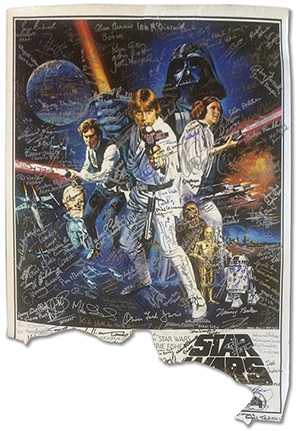
Damage to more than the printed poster
The poster was later severely damaged in transit, with a large lower section torn away and lost. That missing section included numerous signatures, reportedly including names that would be difficult or impossible to replace.
For a collector, this kind of damage is not simply a matter of torn paper. It alters the relationship between the surviving object, the lost material, the signatures that remain, and the story the object can still honestly tell.
Reconnecting the surviving and reconstructed areas
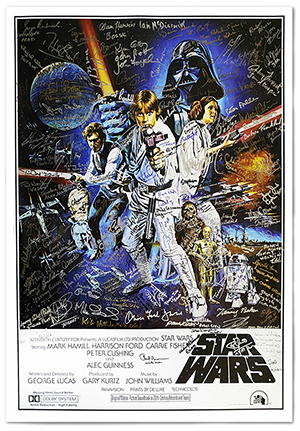
Fine Art Restoration Company's paper conservator restored the poster by connecting a digitally reproduced replacement section with the original signed portion.
The work returned visual coherence to the object while also creating a clear distinction that future records need to preserve: part of the poster remained original and signed before the damage, while another part became a reconstructed and restored area associated with later intervention.
Why restoration documentation matters
A brief note saying “poster restored” would not be enough. Future collectors, insurers, conservators or buyers would need to understand what the poster was before damage, what was lost, what survived, what was reconstructed, who carried out the work, and how the restored object differs from its earlier state.
The before-and-after images are not merely dramatic illustrations; they are evidence of the object's changed condition and restoration history.
What the restoration record should preserve
- The poster's identity and ownership before the damage
- The approximate number and significance of the accumulated signatures
- The circumstances and date of the transit damage
- The location and extent of the missing original material
- Which signatures and physical areas survived the incident
- Which portions of the finished poster are digitally reproduced
- The materials and methods used during restoration
- The name of the conservator or restoration company responsible
- Before, during and after-treatment photographs
- Any recommendations for handling, display, storage or future treatment
Preserving significance while altering originality
The case also shows that restoration can preserve significance while altering originality. Without intervention, the poster may have remained physically compromised and visually disrupted. With intervention, it regained stability and presence, but its documentation became even more important.
The restored poster is not simply the same object made whole again. It is an object with a documented episode of damage, loss, conservation and continuation in its history.
Case study credit
Images and case study courtesy of Fine Art Restoration Company, based on their article “A New Hope: the restoration of beloved Star Wars poster”.
Also see Restoration and Intervention, Collection Documentation and Restoration and Grading.