
Collecting Worlds · Role-Playing Games
A book to use. A world to enter. An artefact that can remember the play.
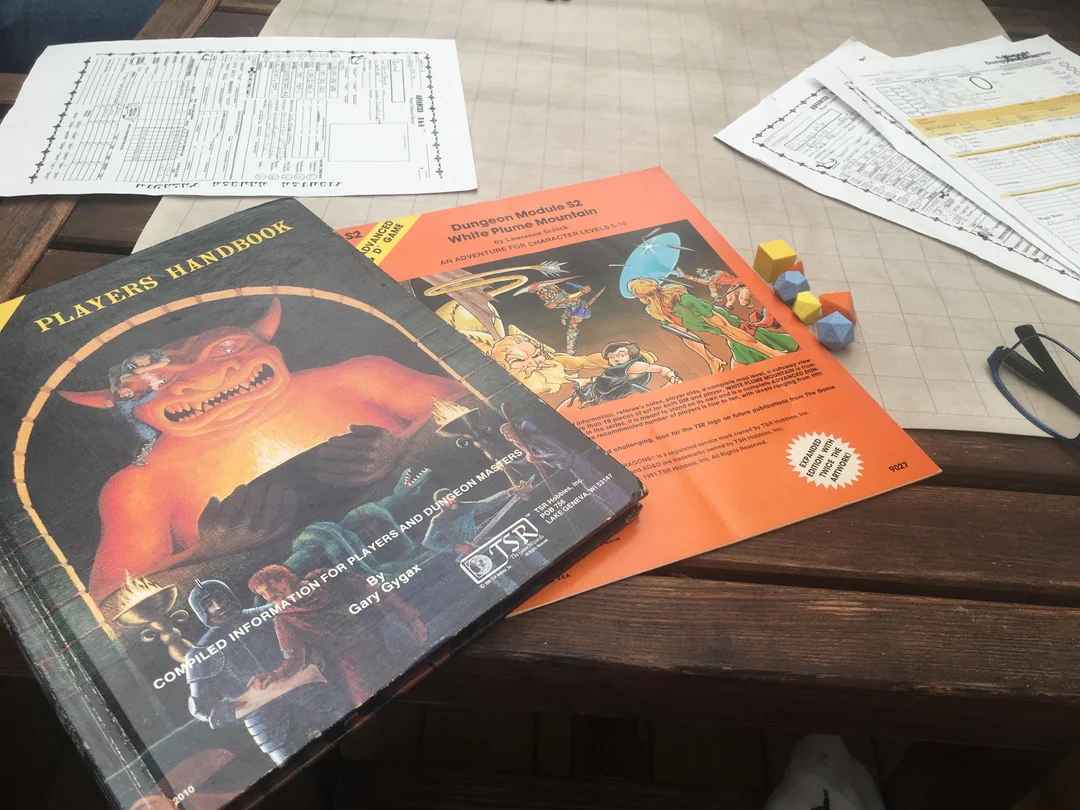
Role-playing-game collecting is difficult to understand from the outside because the same object can be a game tool, a book, a historical document, a nostalgia object, an artwork, a piece of publishing history and evidence of somebody's lived play.
That creates a collecting world where heavy use can damage monetary condition while increasing emotional or historical significance. The untouched copy may be the better commodity. The battered copy may be the better story.
The central idea
The collectible is also a machine for producing experiences
A novel contains a story. An RPG book contains rules, settings and procedures from which thousands of different stories can be produced.
The physical object is not the finished experience. It is one of the instruments that made the experience possible.
Collector behaviour
There is no single RPG collection
Some collections still look like shelves of books. Others become archives of publishing, play, art, ephemera, creator history or a particular fictional world.
Player-collectors
Books remain tools. Notes, unfolded maps, removed handouts and decades of use can be part of the value rather than evidence that value has been lost.
Line completers
A collector may pursue every product for a game, edition, publisher or setting, only to discover that magazines, promos, regional versions and boxed-set variants complicate the boundary.
Edition and era collectors
TSR-era D&D, early Chaosium, GDW Traveller, 1980s British RPG publishing, World of Darkness or the modern OSR can become collecting identities in their own right.
Bibliographical collectors
Logos, stock codes, ISBNs, advertisements, printer details, map colours, addresses and tiny production changes can distinguish one printing from another.
Archaeology collectors
Small-print games, amateur publications, convention releases, fanzines and failed systems can matter because they reveal paths the hobby might have taken.
Creator and provenance collectors
Designer copies, manuscripts, proofs, correspondence, original art and campaign material can transform an ordinary object into evidence of RPG history.
The deeper somebody goes into RPG collecting, the less their collection necessarily resembles a shelf of RPG books.
Completeness
"Complete" can mean four different things before the argument has even started
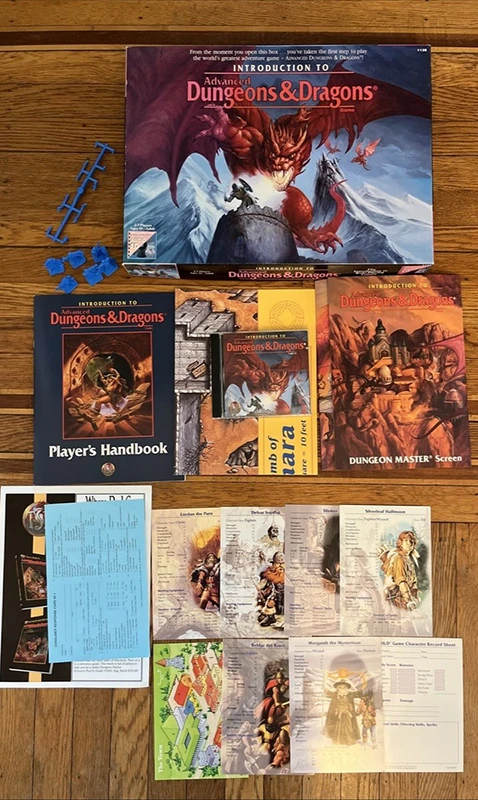
Historical boxed sets complicate completeness because maps, dice, counters, reference sheets, catalogues, crayons, leaflets and registration cards were easily separated or discarded. Some components also changed between production runs.
Play-complete
Everything needed to use the game.
Publication-complete
All primary books and components are present.
Factory-complete
Everything originally supplied is present, including material routinely discarded.
Printing-correct complete
Every component belongs to the correct production configuration. This is where completeness becomes forensic.
A replacement map may make a box usable. It does not necessarily make it collector-complete.
Originality
Completeness and originality are separate axes
A missing component can be replaced with a period original, a component from another printing, a photocopy, an official PDF, a scan or a modern reproduction. All may restore function. They do not create the same collectible.
Is this only the product as originally specified, or the fuller historical package that survived with it?
Condition
There is no single meaningful "best copy"
RPG condition is multidimensional because books, modules, boxes and loose components age differently. More importantly, use can carry meaning.
Books
spine wear, cover rub, staining, foxing, writing, detached pages, binding failure, odour
Modules
cover folds, staple rust, map integrity, detached covers, mismatched booklet and cover
Boxed sets
box condition, books, maps, accessories, inserts, dice and component matching
Loose material
fold splits, missing sheets, mixed components, detached counters, cards and handouts
Near mint. Never played.
Probably strongest by conventional commodity condition.
Worn and annotated through years of play.
Potentially the most emotionally important copy to its owner.
Worn because it was the designer's working copy.
Condition defects can become historical evidence when provenance changes the context.
The archaeology of play
Published books tell only half the story
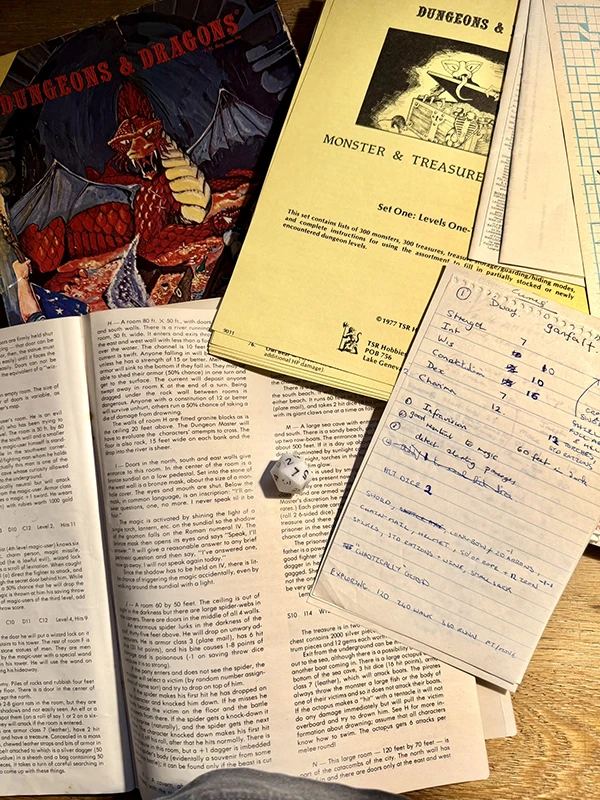
Character sheets, campaign maps, handwritten notes, tournament records, correspondence and homebrew rules document what people actually did with RPGs.
A campaign map may record journeys through a country that never existed. A character sheet may preserve the life and death of somebody who never existed. The event was imaginary. The shared memory is real.
RPG artefacts can become physical evidence of shared imaginary events.
Provenance
Provenance usually means little until suddenly it means almost everything
Nobody normally cares which teenager owned an ordinary 1980s rulebook. But a designer's annotated copy, a manuscript used in development or material from a historically significant campaign occupies a completely different category.
Designer copies, manuscripts, proofs, correspondence and original art can make authorship and development history part of the object.
Campaign notes, maps and character sheets can matter because of the particular people, game or creative history they document.
A collector may call handwriting damage. A curator may call the same handwriting evidence.
Printings and variants
Edition identification is only the beginning
Classic RPG publishing contains production changes that were not always documented cleanly. Collectors often reconstruct sequences from surviving physical evidence.
Logo location, map colour or a short block of withdrawn text can create a distinct collector identity.
The experienced collector reads the object almost like an archaeologist reads stratigraphy.
A newcomer sees what is present. The specialist also notices what should be there but is missing.
Knowledge converts absence into evidence.
Preservation
The fragile part is often not the book
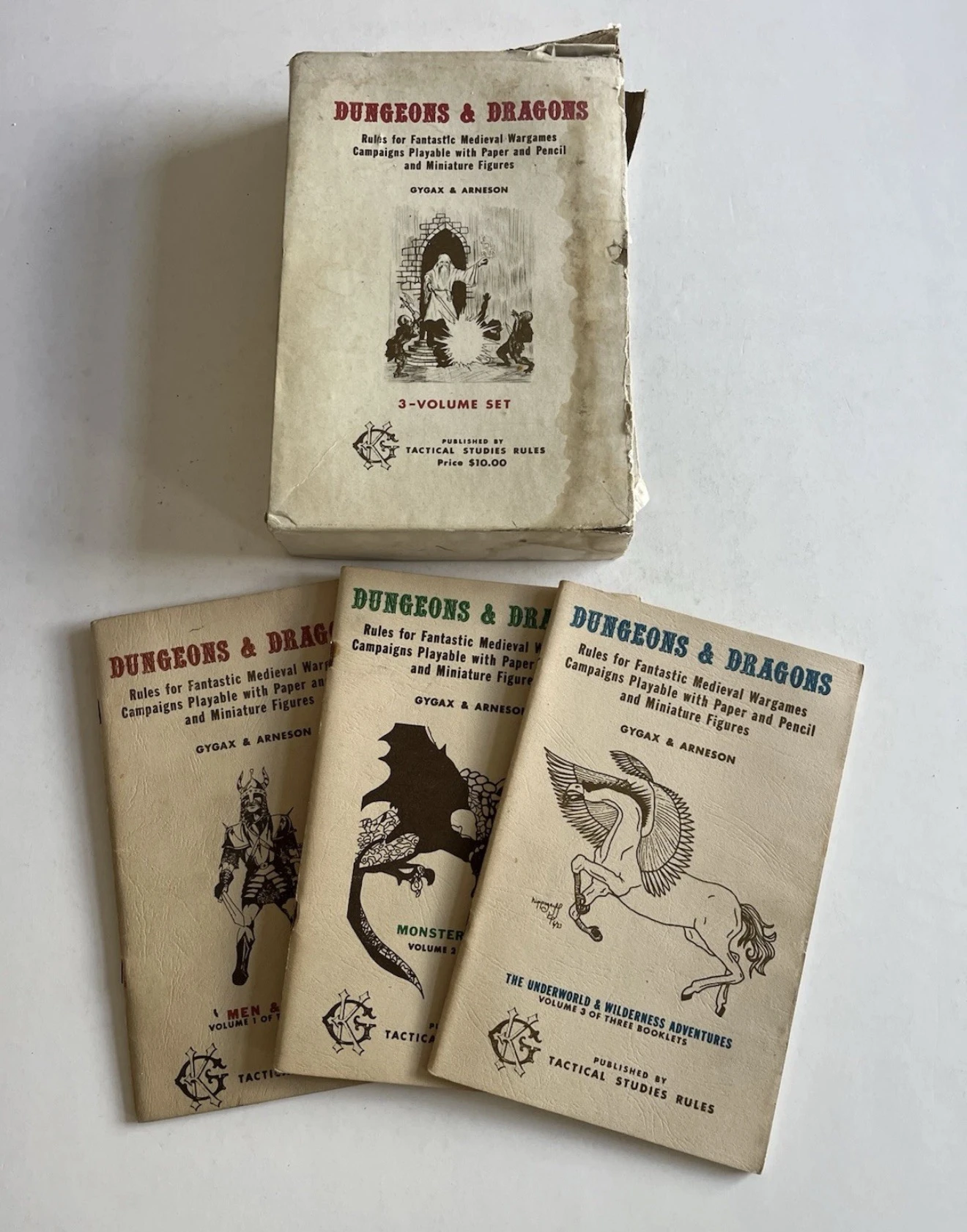
RPG collections combine paper, card, adhesives, staples, plastic trays, maps, counters, dice and unusual packaging. Component integrity becomes a preservation problem in its own right.
A loose map separated from its box can become almost impossible to reunite correctly decades later.
Reprints and digital access
Scarcity of information is no longer the same as scarcity of artefact
PDFs and print-on-demand have changed the relationship between playing and collecting. A reader no longer necessarily needs the rare original in order to access the text.
Reference
Convenient access to the text without handling the vintage object.
Play
A usable physical copy that does not need to pretend it is the historical carrier.
Collect
The physical artefact can now be valued for production history, scarcity and provenance rather than simple access to the rules.
RPG collecting increasingly distinguishes the text from the historical carrier of the text.
Rarity and desire
The hobby collects stories about objects as well as the objects themselves
RPG value can be driven by rarity, historical importance, major-brand significance, visible distinctiveness and decades of collector folklore. Scarcity alone is not enough.
Organic rarity and manufactured rarity are not culturally equivalent
An asking price is evidence that somebody wants the money, not evidence that the object is worth it.
Liquidity and comparables vary enormously outside the best-known D&D material.
Where collectors disagree
The arguments reveal what people believe an RPG object is for
Play it or preserve it?
Writing is damage or history?
Reprint or original?
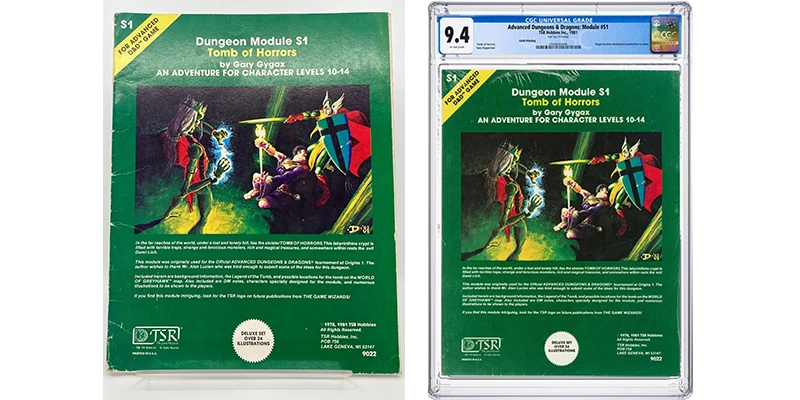
Preservation or slabbing?
Slabbing
Encapsulation creates an unusually stark philosophical conflict
Third-party grading is entering high-value early RPG material, but most authentication still depends on bibliographical comparison, provenance, physical inspection, specialist databases, dealers and community expertise.
Object.
Use me.
The hobby preserving itself
Much of RPG history has been reconstructed by collectors
Publishers did not always preserve printing records, component changes or local variants. Community expertise, dealer knowledge, surviving copies and museum archives have become part of the historical infrastructure.
The Acaeum
A major specialist resource for early D&D bibliography, printing identification, rarity and valuation.
RPGGeek
Broad database infrastructure across systems, editions, publishers, items and collection records.
Noble Knight Games
Large specialist dealer whose grading, buying and out-of-print inventory help shape market conventions.
The Collector's Trove
Particularly important for creator provenance, manuscripts, original art and industry archives.
The Strong Museum of Play
Increasingly important for preserving designer archives and play-generated documents.
DriveThruRPG and indie platforms
Digital and print-on-demand access separates scarcity of the text from scarcity of the original artefact.
The collecting community is simultaneously consumer, archivist, historian and bibliographer.
Collector intelligence
Questions that expose judgement
The emotional engine
RPG nostalgia is often social before it is material
A rulebook can evoke the friend who introduced the game, a school club, a local shop, a campaign that ran for years or the first time somebody became the referee or Dungeon Master.
The collector may be reconstructing an imaginative past as much as a product line.
That is why a commercially ordinary book can remain irreplaceable to the person who used it and has had it for 50 years.
When collecting worlds collide
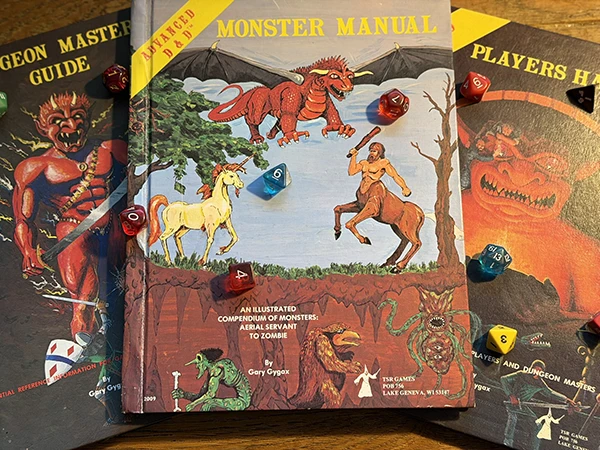
RPG collecting crosses boundaries almost immediately
Books and bibliography, original illustration, miniatures, wargames, fantasy and science-fiction literature, comics, video games, trading cards, board games, toys, convention memorabilia and personal archives can all become part of the same collector's world.
A collector can follow the published line, the fictional world, the creator, the play culture or the wider ecosystem. Those boundaries are not the same.
Possible future explorations
RPG collecting contains several worlds large enough to descend into
Dungeons & Dragons
Its bibliography, variants, TSR history, original art and high-end market are large enough to stand alone.
RPG Original Art
A natural crossover with Fine Art and illustration collecting.
Designer Archives & Manuscripts
Correspondence, playtests, drafts, maps, proofs and production material.
RPG Magazines & Fanzines
Amateur publishing and periodicals preserve parts of the hobby that official histories can miss.
RPG Zines & Indie Publishing
Handmade, risograph, micro-run and creator-led physical publishing has its own collecting culture.
Play-Generated Artefacts
Character sheets, campaign maps, journals and props record what people actually imagined together.
Explore further
The published rulebook tells us what somebody could have played
The surviving campaign artefact tells us what somebody actually imagined together with other people.
This page is an orientation to how RPG collecting behaves, not an attempt to catalogue every game, edition, publisher or setting. The deeper story sits in the relationship between the commercial object, the history of its production and the experiences it helped create.