
Pens
The object never quite stops being a tool.
A pen can be collected as design, mechanism, historical artefact, decorative craft or luxury object. Then the cap comes off, the nib meets paper and another layer of identity appears.
Two pens that look almost identical can feel radically different in use. That makes pen collecting unusually dependent on hidden performance, mechanical coherence and tactile judgement.
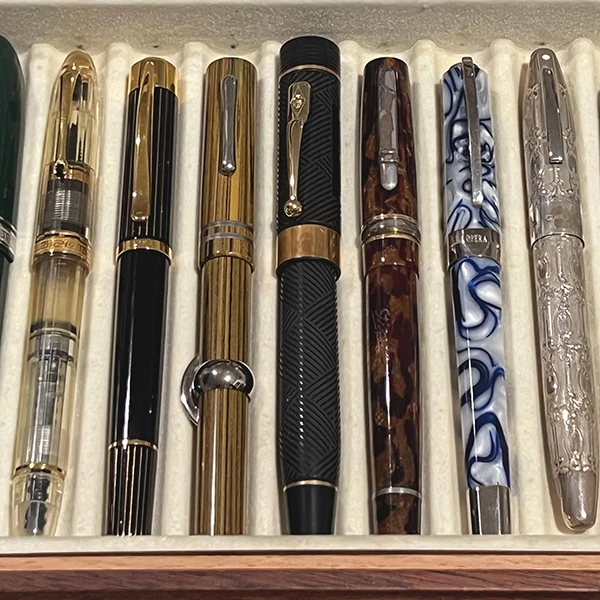
Preserve it - or write with it?
The most important divide in this world is not simply vintage versus modern. It is between the pen as collectible artefact and the pen as functioning instrument - with a large population of collectors occupying both positions at once.
One collector may keep a scarce or pristine example uninked. Another may argue that writing with it is not consuming the object but experiencing it properly. Many maintain separate users and collection pieces.
A pen can be collector-excellent and a mediocre writer - or cosmetically tired and extraordinary the moment it touches paper.
Brand is only the first layer
Pen collections can look superficially similar while being organised around entirely different questions. The same Waterman or Pelikan may matter because of maker, mechanism, nib, production period, market, material or writing behaviour.
Parker, Waterman, Sheaffer, Pelikan, Montblanc, Pilot, Namiki, Sailor and many smaller makers can each support deep specialist collecting.
A collector may pursue one range across colours, trims, production changes, matching pencils and market-specific variants.
Eyedroppers, safeties, lever fillers, pistons, vacuum systems, Snorkels and proprietary experiments can become a collecting programme in themselves.
Width, flexibility, tipping, imprint, grind and writing behaviour can matter as much as the pen body.
Hard rubber, celluloid, precious-metal overlays, urushi, maki-e, raden and modern resins produce very different collecting cultures.
Some collections are organised around pens that create particular writing experiences rather than around historical taxonomy.
The nib can matter more than the pen
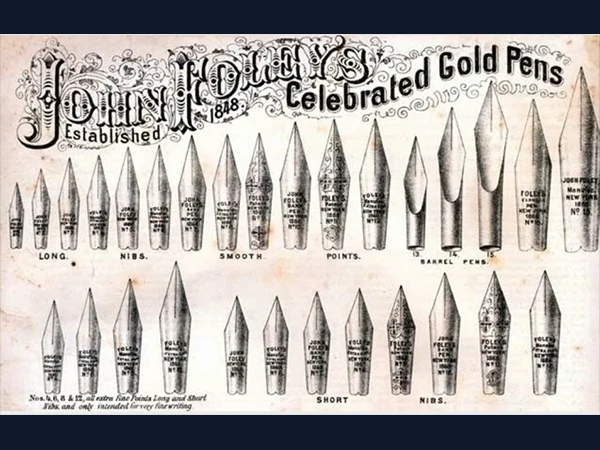
To an outsider the nib is simply the writing point. Specialists read maker, gold content, period, size, imprint, tipping, width, rigidity, softness, flexibility, responsiveness, spring-back, smoothness, feedback, flow and grind.
Terms such as stub, italic, architect, music, semi-flex and wet noodle describe writing experiences that are difficult to infer from a photograph. A visually modest vintage pen with an exceptional responsive nib can be more desirable to a specialist than a spectacular example fitted with an ordinary one.
The most desirable component of a pen may be the part a sales photograph tells you least about.
What does it feel like to write with?
Pen collecting contains information that cannot be fully represented by catalogue data or static images. Flex, feedback, flow, balance and mechanical feel are experienced through use. This makes expertise unusually tactile.
The inside can be more collectible than the outside
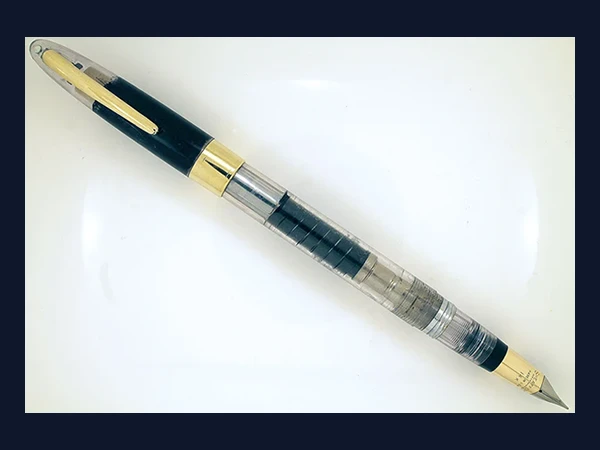
Eyedroppers, safety pens, lever fillers, button fillers, pistons, vacuum systems, pneumatic fillers and proprietary experiments turn the field into miniature industrial archaeology.
The Sheaffer Snorkel is a classic example: a retractable tube allowed filling without immersing the nib. Early Waterman self-fillers tell a different story - experimental mechanisms that can be historically fascinating precisely because later engineering replaced them.
Factory demonstrators make this logic literal. Some were produced to reveal internal workings to dealers rather than for normal retail use, combining rarity with technical evidence.
Some collectors are not really collecting pens. They are collecting solutions to the problem of moving ink.
A small collecting universe can become fractal
A project that begins with every colour of one model can expand into trims, nibs, fillers, export variants, retailer issues, matching pencils and production states. Collector scholarship can then reveal variants that contemporary catalogues never described clearly.
Does a complete collection contain what the manufacturer intended to sell, everything it actually manufactured, or everything collectors now know escaped the factory?
Vintage collectors often study states rather than editions
Clips, cap bands, nibs, feeds, logos, plastics, trim metals, barrel construction and manufacturing locations changed during production. Wartime restrictions, export requirements and supplier changes could alter a pen without creating a formally announced new model.
Which model is this?
Which production state?
One grade hides too much
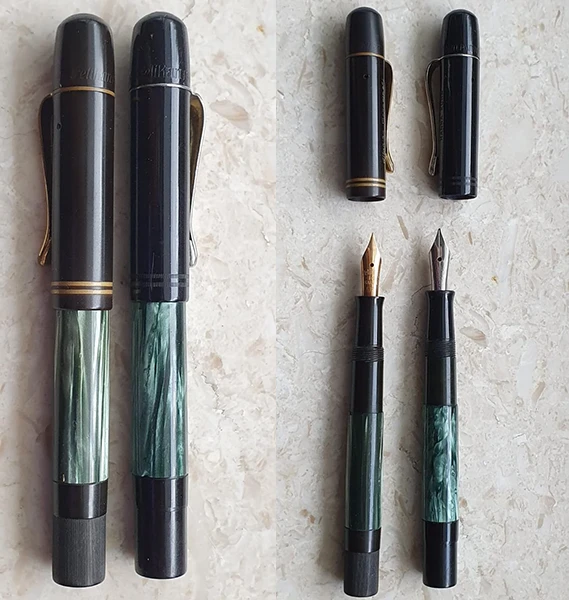
Pen collecting has no universally dominant third-party grading system. Dealer terms such as mint, excellent or very good are house language rather than a shared professional scale, so experienced collectors tend to read condition component by component.
Cracks, warping, scratches, bite marks, staining, shrinkage and distortion.
Fading, oxidation, colour loss, celluloid deterioration, hard-rubber discolouration and lacquer damage.
Brassing, plating loss, dents, loose clips, worn engraving and damaged filling hardware.
Crisp factory markings can be disproportionately important because polishing can erase them permanently.
Correctness, tipping, alignment, cracks, sprung tines, corrosion, previous grinding and writing quality.
A visually immaculate pen may still contain a hardened sac, seized piston or fragile internal component.
Boxes, instructions, converters, price stickers, matching pencils and presentation material can change collector appeal.
A never-used old pen can still be mechanically unfit for use.
Usability makes the originality boundary unusually complicated
Pens contain components that were always expected to perish or be serviced. Replacing a hardened rubber ink sac in a century-old lever filler is normally treated as routine restoration rather than a fatal loss of originality.
Other interventions are much more consequential: aggressive polishing, replating, recolouring, rebuilding broken parts, replacing the original nib or assembling a stronger-looking pen from multiple donors.
Sac replacement, careful seal work, appropriate piston servicing, conservative nib alignment.
Over-polishing, replating, recolouring, incorrect replacement nibs and reconstruction from unrelated parts.
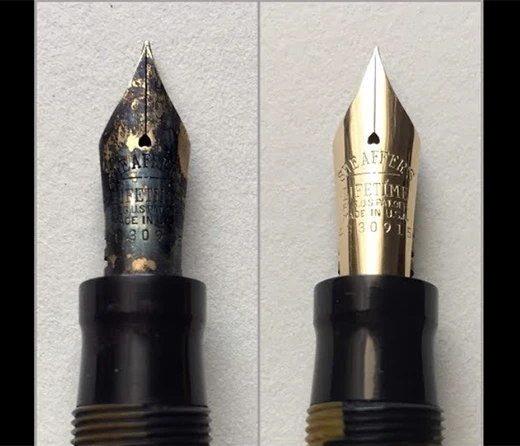
The useful question is not simply "Has this pen been restored?" but "What was done, why, and what original evidence disappeared?"
A repaired pen and a reconstructed pen are not automatically the same thing
Interchangeability makes the boundary contested. A modern nib swap may be routine customisation. A historically incorrect nib fitted to a scarce vintage pen can materially change collector status. An appropriate period replacement sits somewhere between, depending on the collector's philosophy and the intended use of the pen.
Counterfeits are only half the problem
Luxury names attract outright counterfeiting, but vintage collectors also worry about enhancement: reproduction parts, fake demonstrator components, transplanted overlays, mismatched nibs, reconstructed colour combinations and excessive restoration.
Is the object itself authentic?
Are the nib, feed, cap, barrel and trim authentic components rather than reproductions?
Are those genuine components appropriate for this model, period and market?
Were these components historically together, or has the pen been reconstructed later?
A pen can be authentic and still be historically incoherent.
Some pens cross into decorative art
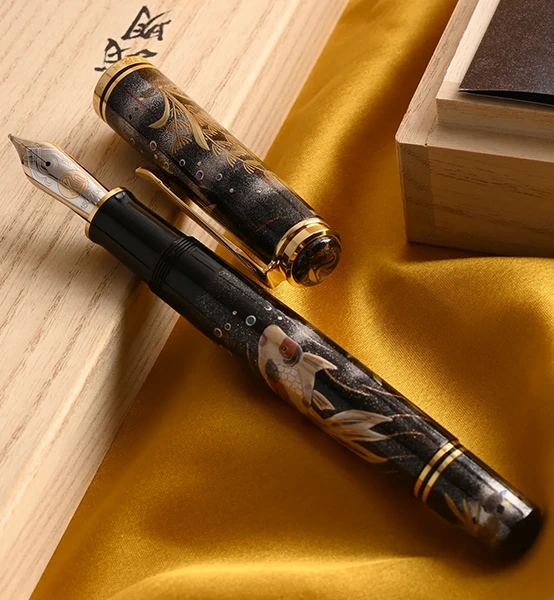
Japanese lacquer pens form one of the strongest specialist branches of the field. Urushi, maki-e, raden and chinkin introduce artisan identity, technique, motif, execution quality, lacquer condition, edition size and workshop lineage into the collecting equation.
In this territory the object can operate simultaneously as writing instrument, decorative artwork, artisan object and numbered collectible. The maker name alone no longer describes what collectors are evaluating.
The closer a pen moves towards craft art, the more attribution can shift from brand to hand, workshop and technique.
Rare is not the same as wanted
An obscure failed model may be genuinely rare yet attract little demand. An abundant iconic Parker, Pelikan or Montblanc can remain highly liquid because collectors repeatedly want strong examples.
Desirability can come from colour, size, mechanism, historical importance, brand reputation, nib quality, visual appeal, ease of restoration or scarcity within a popular series. Condition rarity matters too: a mass-produced pen can become difficult to find with crisp colour, trim and imprints intact.
Modern collecting changed where rarity comes from
Vintage scarcity is often accidental: low survival, obscure variants, short production runs or undocumented factory changes. Modern scarcity is frequently designed through numbered editions, retailer exclusives, regional colours, collaborations, anniversary models and event releases.
Collectors reconstruct what happened after the fact through objects, catalogues and surviving evidence.
Scarcity is part of the release architecture itself: announcement, anticipation, launch, sell-out and secondary market.
Scarcity has moved from something collectors discovered to something manufacturers can deliberately manufacture.
Usually secondary - until it becomes the main object
For an ordinary vintage pen, model, condition, nib and rarity usually outweigh a chain of ordinary ownership. Provenance becomes transformative when the pen can be tied convincingly to a historically significant person, event or institution.
At that point two identities separate: the pen as a manufactured product and the pen as a witnessed historical object. The same physical pen can move from one category to the other because of evidence rather than physical change.
Provenance does not always add a premium gradually. Sometimes it changes what kind of collectible the object is.
Knowing how not to test a pen is part of expertise
"Plastic" is far too broad a category for preservation. Hard rubber, casein, celluloid, acrylic, early plastics, precious metals, plated trim and lacquer all age differently. Heat, ultraviolet light, moisture, abrasion, chemical interaction and off-gassing can matter depending on material.
Mechanical preservation matters just as much. Old sacs harden and pistons seize. Forcing an unknown filler can turn a service problem into a broken lever, cracked barrel or destroyed component.
In pen collecting, curiosity can damage the object before the collector has learned what the mechanism is trying to tell them.
The experienced collector assesses coherence
Expertise is not merely recognising a model. It is asking whether every visible and tactile component tells the same historical story.
Does every component belong to the same pen history?
The archive matters - but handling still teaches what documents cannot
Serious vintage collecting is research-heavy. Collectors reconstruct production dates, colours, export variants, numbering systems and patent histories from catalogues, advertisements, repair manuals, trade material and surviving examples.
Yet much specialist knowledge remains distributed among long-term collectors, dealers, repairers and brand specialists. Physical comparison builds a kind of memory that no database can fully replace: how a cap fits, how a piston feels, how old hard rubber looks under light, or what genuine vintage flex feels like on paper.
Part market, part workshop, part social ritual
Pen shows bring together vintage dealers, manufacturers, independent makers, ink companies, paper companies, restorers, nib specialists, collectors and calligraphers. A nibmeister may tune a pen while the owner waits. Visitors can test inks, handle mechanisms, compare materials and learn through conversation.
Trying the object is not a side activity. It is part of how knowledge moves through the collecting world.
Pen collecting increasingly extends beyond the pen
Contemporary fountain-pen culture often combines pen, nib, ink and paper as one sensory system. Bottled inks have developed their own language of shading, sheen, shimmer, saturation, permanence, lubrication, wetness and chromatography. Journalling, handwriting and Japanese stationery broaden the culture further.
History, makers and reconstruction
The organised vintage tradition is strongly maker-led and research-led. Collectors reconstruct company history, models, patents, production states and variants from surviving evidence.
Participation, colour and intentional writing
Contemporary communities include inexpensive pens, inks, journalling, bespoke grinds, independent makers, Japanese stationery and social sharing. The centre of gravity has partly moved from collecting old pens to participating in fountain-pen culture.
Small terms carry large distinctions
New old stock - old inventory that was never sold or used. It does not automatically mean mechanically perfect.
Wear through plated trim that reveals the underlying metal.
The component beneath the nib that regulates ink and air.
Pressure-responsive tine movement that creates line variation.
Collector slang for an exceptionally soft and responsive vintage flexible nib.
Two parallel lines caused when flexing outruns the available ink flow.
A specialist who tunes, adjusts or reshapes nibs.
A transparent pen, historically sometimes made to reveal internal mechanisms and now also a normal design category.
A pen assembled from mismatched or non-original components.
A pen valued primarily as a functional writer rather than a pristine collector specimen.
A deeply desired personal target, not an objective rank of rarity or value.
Obsolescence gave the pen a second life
The fountain pen was once ordinary technology. Digital tools made it unnecessary, and that lack of necessity changed its meaning. Writing with one became a deliberate choice involving touch, pace, ink, paper and handwriting.
That helps explain why one collection can contain a cheap modern Chinese pen, a 1930s Parker, a handcrafted Japanese lacquer pen and an expensive Montblanc without contradiction. The common thread may be intentional writing rather than price or period.
A grail can be an £8,000 decorative pen, an obscure Waterman, a discontinued colour, a particular nib or a modest pen that took years to find.
The term is revealing because it describes personal culmination rather than an objective market hierarchy.
Questions that expose judgement rather than inventory
Identity is the relationship between object, components, intervention and use
Pens are particularly strong evidence that authenticity, condition and restoration cannot always be represented as single labels. A pen can be genuine but incorrectly assembled, restored but more usable, worn but mechanically superb, complete under one catalogue and incomplete under later scholarship.
Catalogue identity tells you which pen this is. Coherence tells you whether the surviving object still tells one believable story.
Several branches are strong enough to stand alone later
The core page works as a complete collecting-world overview, but the research opens several natural routes into deeper Collectaneum pages without making this page depend on them.
Maker history, production states, variants and archival reconstruction.
Flex, specialist grinds, tuning, performance and tactile expertise.
Urushi, maki-e, raden, chinkin, artisan attribution and decorative craft.
Mechanical history from eyedroppers and safeties to Snorkels and vacuum systems.
Release culture, retailer exclusives, collaborations and engineered scarcity.
Servicing, intervention history, replacement ethics and specialist repair.
Colour, chemistry, shading, sheen, shimmer and its own enthusiast infrastructure.
Mechanical pencils, ballpoints, rollerballs, desk sets and historical dip pens.
The most valuable knowledge may be felt rather than photographed
Pens are particularly suited to interviews with collectors, restorers, dealers and nib specialists because so much expertise sits in physical comparison, mechanical feel and accumulated judgement.
Explore Collecting Intelligence →Pens turn general collecting principles into practical decisions
Condition, authenticity, preservation, restoration, provenance and valuation all become clearer when separated into the evidence that survives on the object and the interventions that changed it.
Explore the Knowledge Center →