
Barbie
The doll is only one component of the collectible.
Barbie collecting can mean a 1959 Ponytail, a complete vintage wardrobe, a Steffie-face run, a Japanese-exclusive fashion, a pristine boxed Silkstone, a Dreamhouse, a designer collaboration or a fully reworked OOAK doll.
What makes Barbie distinct is not simply scale or fame. It is the depth of the internal collecting language: production states, face sculpts, body types, fashions, packaging, regional variants, restoration culture and competing ideas about whether the object should be preserved or actively used.
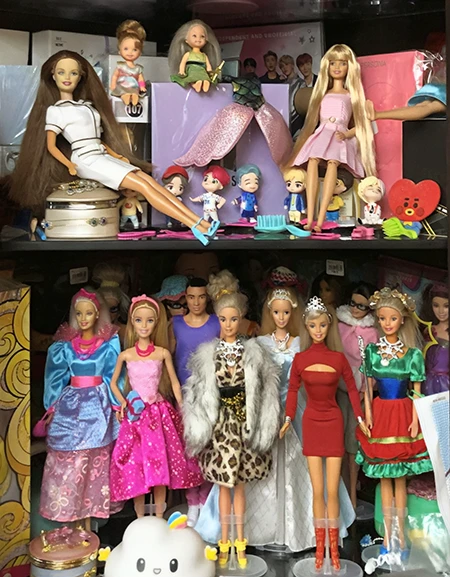
Collectors do not simply collect Barbie dolls. They collect the Barbie system.
Barbie is unusually collectible at different levels of resolution. One collector may want a single childhood doll. Another may pursue every recognised Ponytail production state. Another may ignore character names and collect only a face sculpt across many releases.
Fashion, packaging, houses, furniture, vehicles, catalogues and tiny accessories can all become independent collecting programmes. The boundary is defined by collector logic rather than by the silhouette of the doll.
Barbie can be collected by character, sculpt, era, wardrobe, region or idea
These boundaries overlap. A single doll can satisfy several collector programmes at once, which is why the hobby resists one universal definition of a complete collection.
Barbie herself, Ken, Skipper, Midge, Christie, Francie and the wider cast.
Ponytail, Bubble Cut, Mod, Malibu, SuperStar, 1980s, 1990s, Y2K or a tightly bounded release period.
Steffie, SuperStar, Mackie, CEO / Generation Girl, Goddess, Lara and other sculpt families.
Named outfits, complete wardrobes, footwear, jewellery, handbags, gloves, hats and miniature accessories.
Bob Mackie, fashion collaborations, Mattel designers or a particular collector line.
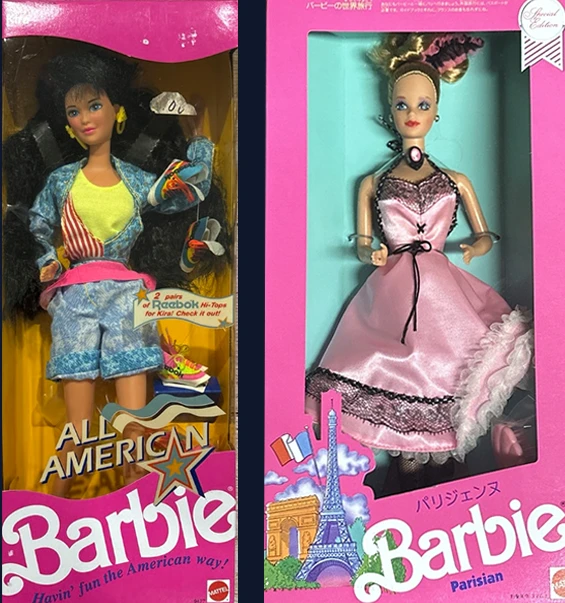
Japanese, European, Canadian and other market-specific dolls, fashions, packaging and production differences.
Dreamhouses, furniture, vehicles, playsets, catalogues, booklets, boxes and promotional material.
Representation milestones, careers, celebrity, film, music, national identity or fashion history.
There is no useful concept of owning all Barbie. The meaningful question is where the collector chooses to draw the boundary.
The experienced collector asks "what production state is this?"
Early Barbie chronology is not a neat sequence of dates. Ponytail, Bubble Cut, Fashion Queen, Swirl, American Girl, Color Magic, Twist 'N Turn, Mod, Malibu and SuperStar describe changing design languages and production configurations.
Copyright markings alone can mislead. Identification emerges from the combination of face, hair, body, markings, outfit and package evidence.
Sculpt, screening, eye direction, brows, lip colour and paint style.
Factory rooting, colour, original set, cut hair, missing plugs or rerooting.
Construction, waist, leg articulation, hand mould, skin tone and body markings.
Country and copyright markings help identify production context, but are not simple release dates.
Fabric, labels, zips, snaps, accessory combinations and stock-number logic.
Box style, inserts, ties, wrist packaging, ribbons, booklets and regional stickers.
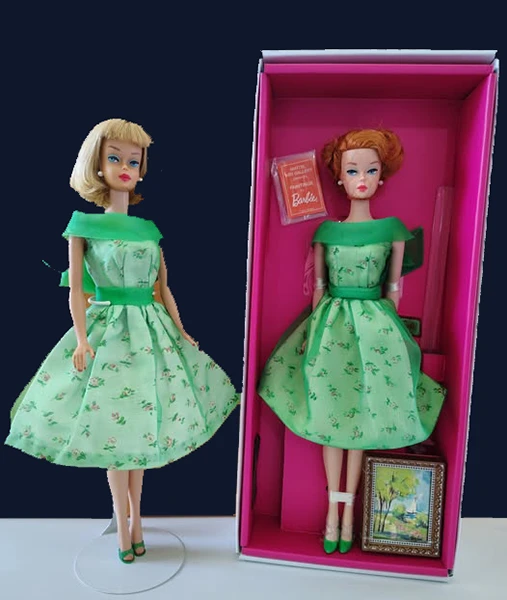
The specialist eye decomposes the doll before it evaluates the whole.
"That is a Steffie sculpt" is not the same as "that is Steffie"
Barbie collectors distinguish character identity from sculpt identity. The character Barbie has worn many different faces, while one sculpt can appear across Barbie, friends and unrelated characters.
This creates a specialist taxonomy invisible to many outsiders. Steffie, SuperStar, Mackie, CEO / Generation Girl, Goddess and Lara can function as collecting categories in their own right.
A similar distinction appears with Silkstone and the Barbie Fashion Model Collection. Silkstone describes a material and body technology. BFMC is a specific collector line associated with it. They are related, not synonyms.
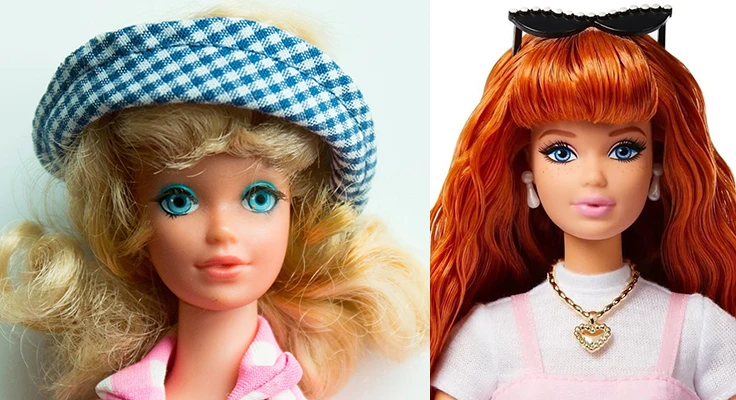
The name printed on the box is not always the most useful way to describe what a collector is actually seeing.
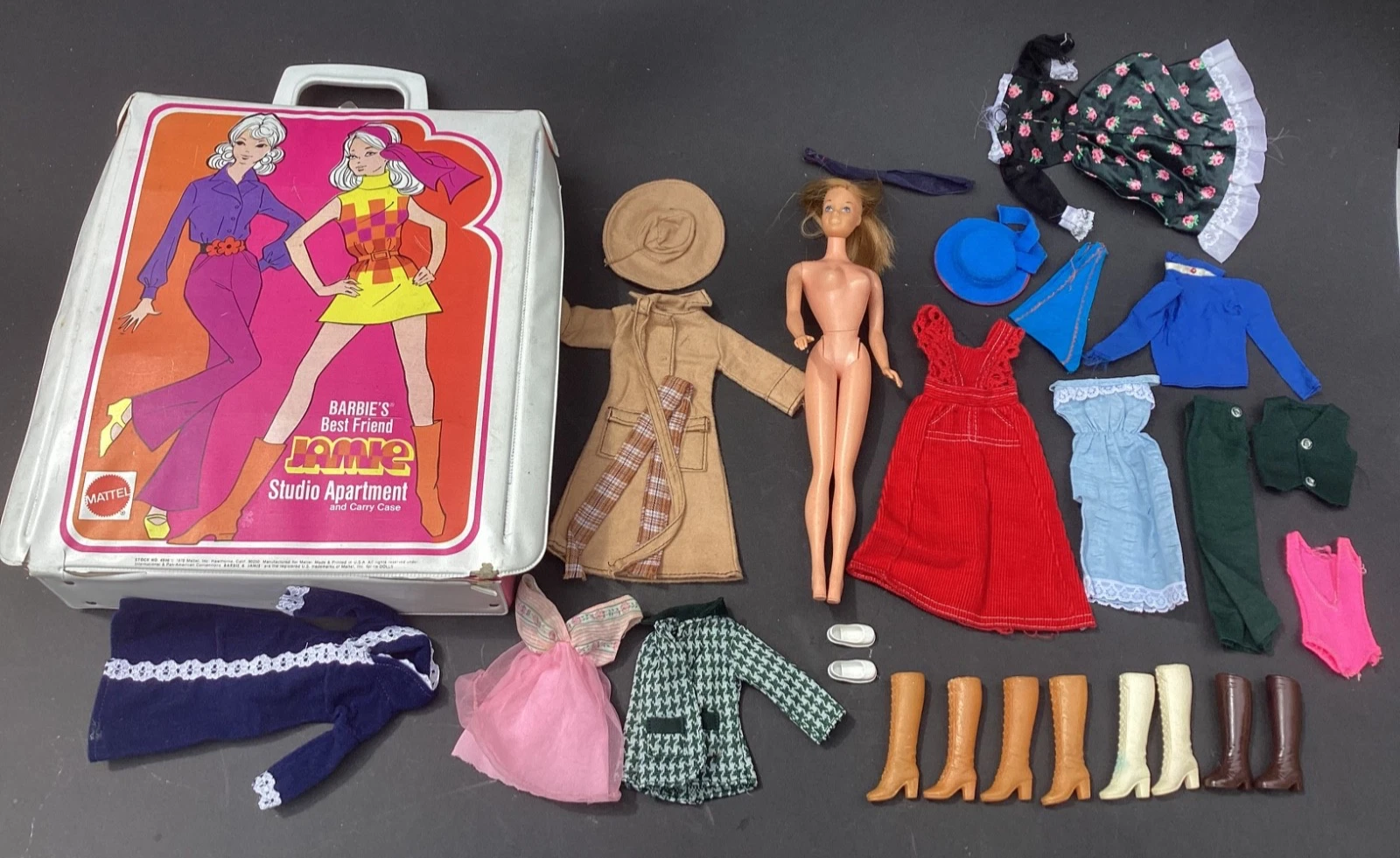
A rare outfit can matter more than the doll wearing it
Barbie's early fashion system gave named ensembles their own stock numbers and accessory structures. Collectors therefore catalogue wardrobes independently of dolls.
Identity can depend on fabric, cut, labels, zips, snaps, shoes, gloves, jewellery, purse, hat, belt, stockings, booklet and packaging. A jacket can be correct while the ensemble is still materially incomplete.
The result is one of Barbie collecting's most revealing inversions: a common doll can become highly desirable because of what she is wearing.
Fashion is not decoration attached to the collectible. It can be the collectible.
Complete becomes forensic
For an early Barbie, completeness can extend from the correct doll to swimsuit, shoes, sunglasses, earrings, stand, booklet, box, liner, tissue, original hair setting and even surviving factory-era rubber bands. For a modern collector edition it may mean stand, certificate, accessories, internal packaging and shipper.
Everything supplied with the issue survives in the correct configuration.
Every component of a named ensemble is present, including small and easily lost accessories.
Every doll or fashion inside a collector-defined sequence has been obtained.
The collector has fulfilled a self-imposed theme such as every Steffie-face Barbie or every Bob Mackie issue.
Completeness is not one field. It can describe factory state, outfit state, series state or the fulfilment of a collector's own rule.
Authentic is not a simple yes-or-no question
Barbie complicates the usual original-versus-fake binary because Mattel itself has issued later reproductions of earlier dolls and fashions. A component can be genuine Mattel and still be wrong for the period or present configuration.
A Barbie can be authentic Mattel but not original to its present configuration.
Barbie condition has its own pathology
Generic words such as mint or excellent are not enough. Experienced collectors look for forms of deterioration that are specific to vinyl dolls, metal accessories, rooted hair, elastic, textile and long-term storage.
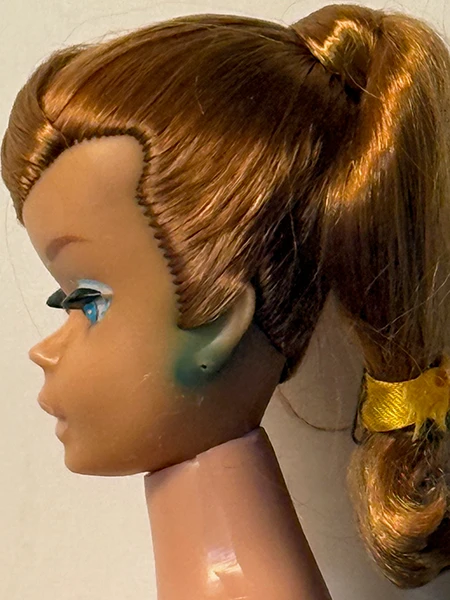
Metal earrings can produce green discolouration in the vinyl around the ear.
Ageing plastics and migrating additives can alter surface appearance and feel.
Yellowing, fading, darkening or uneven limb and face colour can materially affect desirability.
Factory hair is part of identity; trimming, missing plugs and reroots change originality.
Neck splits, trunk splits and loose or damaged joints alter both display and structural condition.
Original face paint can be more desirable than a visually cleaner retouched face.
Fading, staining, brittle elastic, corrosion and missing trims can undermine a complete-looking outfit.
Smoke, mould and long storage histories can survive invisibly until the box is opened.
Never removed from box is both evidence and risk
NRFB can act simultaneously as condition language, provenance claim, completeness claim and evidence of original configuration.
Factory ties, accessory placement, original hair set, inserts, packaging relationships and evidence of how Mattel intended the doll to be presented.
Plasticisers migrate, metals react, fabrics fade, elastic fails and mould, staining or colour shift can develop inside an apparently untouched box.
Untouched state and preserved state are not always the same thing.
Preserve the object
For some collectors, the box is part of the artefact. Original ties, accessories and factory arrangement should remain undisturbed because they preserve evidence that can never be recreated with certainty.
Use the doll
Other collectors deliberately debox expensive dolls to dress, photograph, pose, handle and restyle them. For them, leaving Barbie sealed can feel like refusing the very mode of ownership the object was designed to invite.
The argument is not boxed versus unboxed. It is artefact preservation versus participatory ownership.
The same intervention can be damage, repair or art
Barbie has a large hands-on culture of cleaning, hair washing, rerooting, repainting, stain treatment, joint repair, limb replacement, clothing repair and accessory reproduction. What matters is the collector context.
Stabilise vulnerable original material and prevent further loss with minimal visible change.
Repair clothing, clean carefully, correct hair or replace compromised parts in order to recover an earlier appearance.
Use replacement or reproduction components to create a more complete configuration while reducing originality.
Reroot, repaint, rebody and redress deliberately. The doll becomes a creative platform rather than a preserved factory artefact.
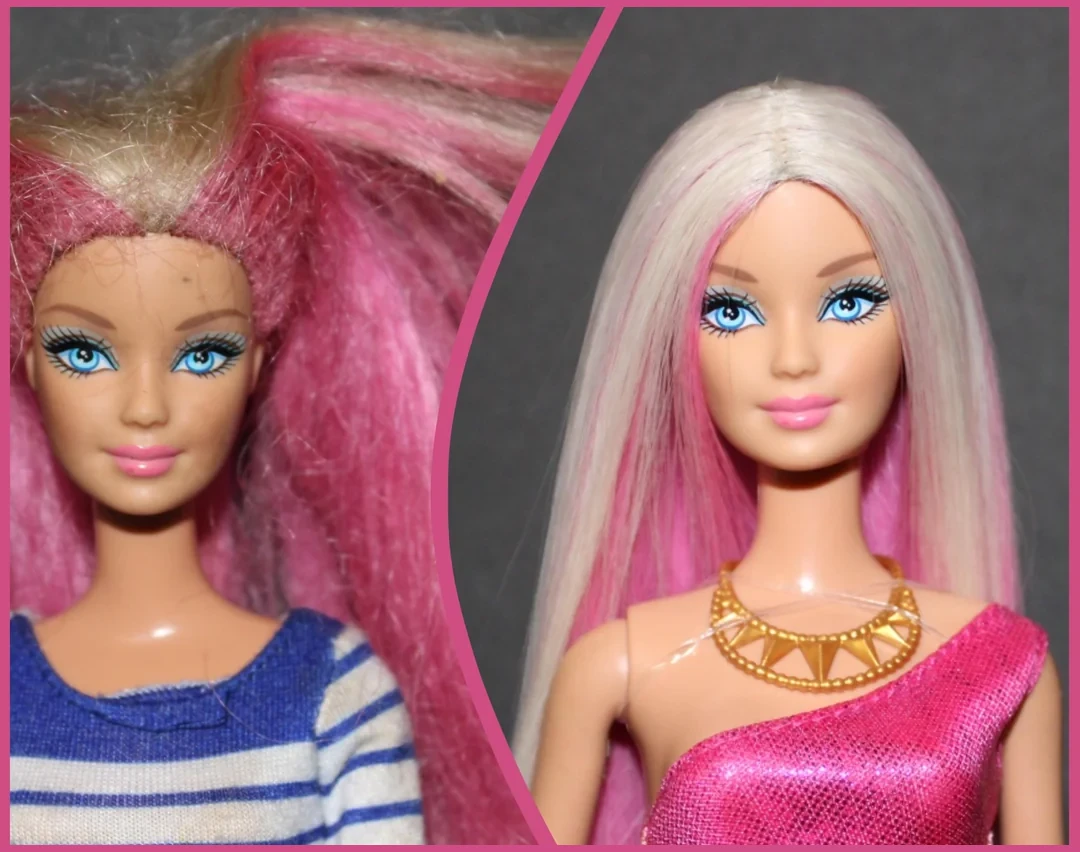
A flawless repaint can be less desirable to a vintage purist than worn original face paint. The same repaint can be highly valued in a custom competition where originality and creativity are the point.
Context determines whether intervention destroys one kind of value or creates another.
"Wrong" can be completely correct in another market
Japanese Barbie is particularly important. Collectors study exclusive ensembles, changed fabrics, different accessory combinations, altered boxes, booklets, tariff stickers and legitimate untagged fashions.
Later production across Taiwan, Hong Kong, Korea, the Philippines, Mexico and elsewhere created further distinctions. Experienced collectors learn not to treat difference from an American reference example as evidence of replacement.
International knowledge often begins where the standard catalogue stops.
Rare does not automatically mean wanted
Barbie gives an unusually clear demonstration of the gap between scarcity and desire. A little-known variant can be genuinely scarce but attract limited demand, while an iconic mass-produced doll can remain culturally desirable for decades.
Children played with dolls, cut hair, lost shoes, separated outfits and discarded packaging.
Some variants, outfits and configurations were sold only in particular regions or channels.
An iconic Barbie can remain highly desirable even when original production was enormous.
A common doll in an exceptionally complete early configuration can be far harder to replace than the doll alone.
Age-sensitive vinyl, paint, fabric and packaging mean strong survivors may be much scarcer than production numbers imply.
Barbie desirability is better understood as rarity x recognition x condition x completeness x nostalgia.
Vintage scarcity was often accidental. Modern scarcity can be designed.
Hair was cut, accessories disappeared, packaging was thrown away and regional releases had limited distribution. Rarity emerged through use, loss and survival.
Collector labels, member exclusives, priority windows and limited drops can make scarcity part of the release mechanism itself. The challenge is sometimes not discovering a scarce object later, but successfully buying it at launch.
Scarcity can be the residue of history or a feature of product design.
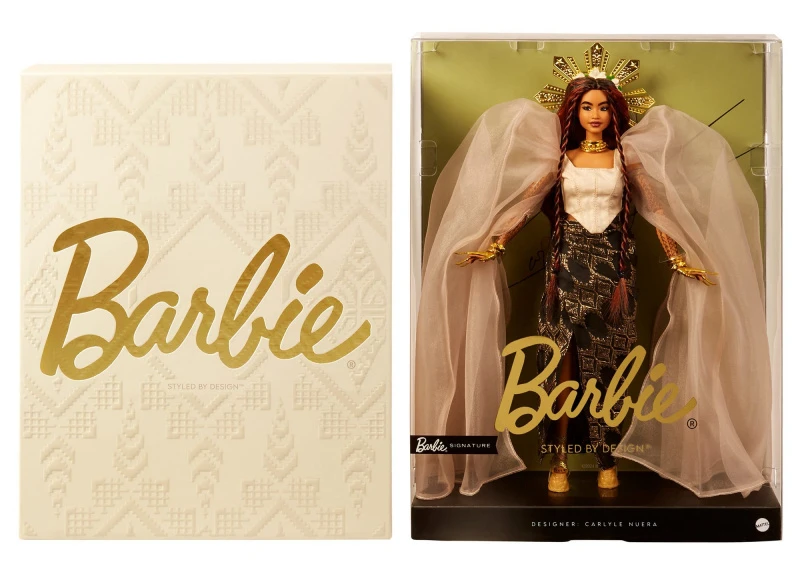
Mattel does not merely make the objects. It helps organise the collecting culture.
Barbie Signature, Club 59, limited editions, member access, certificates, named designers, face-sculpt information and collector content make Mattel part producer, archivist, community host, scarcity creator and gatekeeper.
That relationship is unusually important because collectors can participate enthusiastically in the ecosystem while also criticising engineered scarcity, difficult purchase windows and the idea that collector status should be designed into a product at manufacture.
Barbie remains comparatively unslabbed
Barbie changes hands through eBay, specialist dealers, doll shows, conventions, auctions, private sales, estate sales and collector groups. High-value material exists, but there is no single CGC- or PSA-style grading system organising the hobby.
Connoisseurship stays close to the object
Identification, comparison photography, seller reputation, reference books, body markings, packaging evidence and specialist judgement often matter more than a universal numeric grade.
The market can price a doll. It still depends on collector knowledge to decide what doll is actually being priced.
Provenance matters selectively, but sometimes very practically
Most Barbies do not need a distinguished ownership history. For common dolls, identification and condition dominate. Provenance becomes more useful when it helps establish originality, explain an unusual regional configuration, support a prototype claim or connect an object to Mattel staff, a designer, a presentation context or celebrity ownership.
A coherent early doll retained by the childhood owner with its accessories can make an unusually complete configuration easier to understand.
A childhood story does not make a common Barbie rare. It may, however, support why the doll, outfit and small components belong together.
Provenance can be academically modest but materially useful.
The experienced collector learns by repeated visual comparison
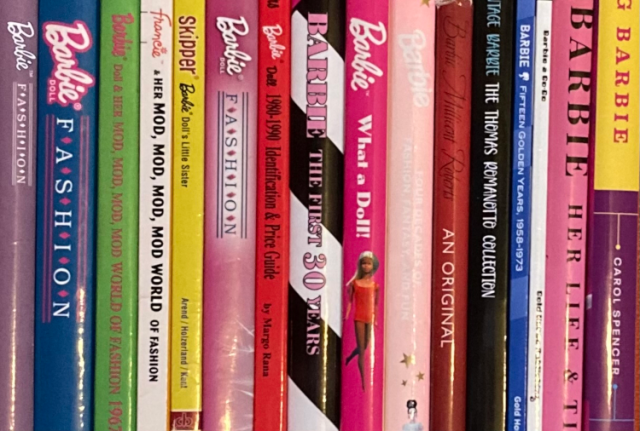
Barbie knowledge is both bibliographic and visual. Collectors study body markings, head moulds, hair, face paint, lip colour, construction, labels, shoes, fabrics, packaging and catalogues until tiny differences become meaningful.
A 1960s Barbie.
Ponytail or Bubble Cut? Which face paint? Which hair colour? Correct head and body? Original hair set? Correct swimsuit? Correct shoes? Japan marking? Green ear? Retouch? Reproduction accessories? Regional issue? Retied box?
Barbie has its own formal collector infrastructure
Conventions, competitions, specialist reference books, digital databases, dealer networks and collector communities do more than support buying and selling. They codify what counts as authenticity, rarity, condition, completeness and creative excellence.
Authenticity, rarity, condition and completeness reveal the value system of preservation-led collecting.
Originality, creativity and thematic expression legitimise Barbie as a medium for transformation.
Preserve Barbie / reinvent Barbie. Both require expertise, but they reward different forms of judgement.
Barbie belongs to doll collecting without being reducible to it
Barbie shares the wider Dolls world's concerns with materials, repair, clothing, maker history, body construction and preservation. But its internal taxonomy, fashion bibliography, face-sculpt culture, regional variants, NRFB ideology, modern collector programme and customising ecosystem are unusually self-contained.
The useful relationship is therefore Dolls ↔ Barbie: adjacent collecting worlds with genuine overlap, rather than Barbie functioning as a subsection that dominates the broader history of dolls.
Questions that expose collector judgement
Barbie can be childhood memory, fashion history and self-authorship at once
Nostalgia matters, but Barbie's emotional field is broader than nostalgia. Collectors can respond to fashion, careers, representation, identity, celebrity, design, cultural change and the pleasure of miniature world-building.
A collector may begin by recovering one childhood doll and later migrate into face-sculpt study, vintage wardrobe scholarship, Silkstone, regional material or customisation. The collection can evolve as the collector does.
Barbie is unusually capable of being both a preserved object and a rewritten self.
Collector knowledge lives in the tiny distinctions
Barbie is especially suited to interviews with vintage specialists, fashion collectors, regional experts, convention judges, restoration practitioners and customisers because each group reads the same object differently.
Explore Collecting Intelligence →Go deeper into the practices behind the doll
Plastics preservation, textile care, authenticity, provenance, restoration, storage and intervention become more useful when separated from the collector culture that gives each decision meaning.
Explore the Knowledge Center →