
Collecting World
Arms, Armour & Militaria
The object is rarely just what it was made to be. It is also what happened to it.
This world reaches from ancient arms and historic armour to medals, uniforms, battlefield material, modern military equipment and reconstructed material culture. Collectors do not judge every part of this world by the same rules.
The common thread is the surviving material evidence of how people prepared for conflict, experienced it, represented it and remembered it.
The defining feature
One collecting world - very different rules of evidence
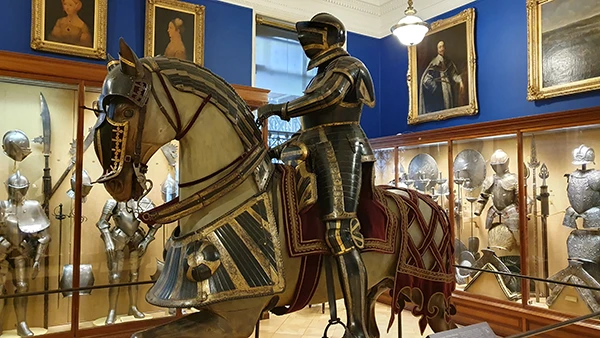
A Roman helmet, a Japanese sword, a named Victorian medal, a German wartime helmet and a reconstructed medieval harness can all sit beneath the same broad heading while demanding radically different standards of proof.
Archaeological context may dominate one object. Workshop practice another. Service records a third. Stitching, paint and rivets a fourth. For some material, accurate reconstruction is itself a serious route to knowledge.
The broad principles are shared. The rules of judgement are not.
What kind of evidence should this object preserve?
Which alterations belong to its historical life?
What would count as an unacceptable modern intervention here?
What specialist knowledge is required before a confident claim can be made?
Condition
Damage, wear and historical evidence are not the same thing
Militaria often resists the conventional collecting ideal of the pristine survivor. These objects were made to be worn, carried, sharpened, fired, repaired, repainted, patched, modified, issued, withdrawn, captured and reused.
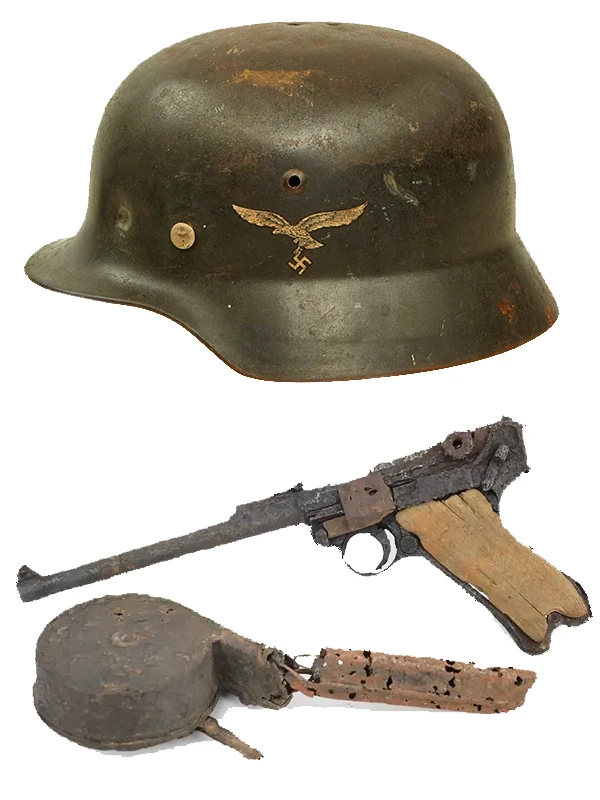
They can also survive through radically different environments. Some remain in cupboards or collections for decades. Others are recovered from fields, trenches, crash sites, collapsed buildings or water, carrying corrosion, mineral deposits, distortion, loss and decay produced by burial or exposure.
A dent can be accidental damage, careless storage or evidence of service. A replaced button can be a modern repair or a perfectly legitimate wartime replacement. Paint can be factory original, depot-applied, field-applied, camouflage, post-war reuse, collector restoration or deliberate deception.
For relic collectors, severe deterioration may not simply be a lower condition grade. A heavily corroded weapon, helmet or piece of equipment can be desirable precisely because its surviving state records where and how it endured. Cleaning it back towards a more conventional appearance may remove the very evidence that gives it meaning.
How intact, attractive and structurally sound is the object now?
How much trustworthy evidence of manufacture, use, repair and history still survives?
An immaculate restored object can be less desirable than a battered survivor whose paint, fittings and history remain convincing.
Untouched
"Untouched" is powerful because surfaces carry memory
Stable patina, wear around fittings, oxidation, old paint, stitching and repair can all contain information. Cleaning and polishing may improve appearance while permanently erasing exactly the evidence a specialist uses to judge age, originality or service life.
"Untouched" does not guarantee quality. It signals the possibility that later intervention has not erased the physical clues needed to understand the object.
Scope
Serious collections often begin with a historical question
Few collectors meaningfully try to "collect militaria". They create boundaries, then sharpen them. The collection becomes a way of investigating a unit, object, period, technology or person.
Conflict
British material from the First World War.
Service
Royal Flying Corps equipment and personal material.
Unit
Objects associated with one regiment, squadron or formation.
Object type
European helmets, cavalry swords or Japanese sword fittings.
Individual
A named serviceman reconstructed through objects and documents.
Question
How did one item change through regulation, manufacture and field use?
A collection can become a historical argument: what did these people actually have, how did this object change, or what happened to this individual?
Completeness
"Complete" can mean kit, entitlement, pattern, variant or evidence
Absolute completion is usually impossible because the possible universe is enormous. Collectors therefore build internal models of completeness that only make sense once scope, period and collecting intent are defined.
A defined kit for a date, rank, theatre and purpose - not simply everything a soldier could ever have owned.
The known entitlement belonging together, where splitting the group can destroy historical meaning.
One example of each principal pattern, model or regulation change.
Maker, marking, factory, size, lot or production variation can become the collecting programme.
Object plus the documentary record needed to reconstruct what happened to it.
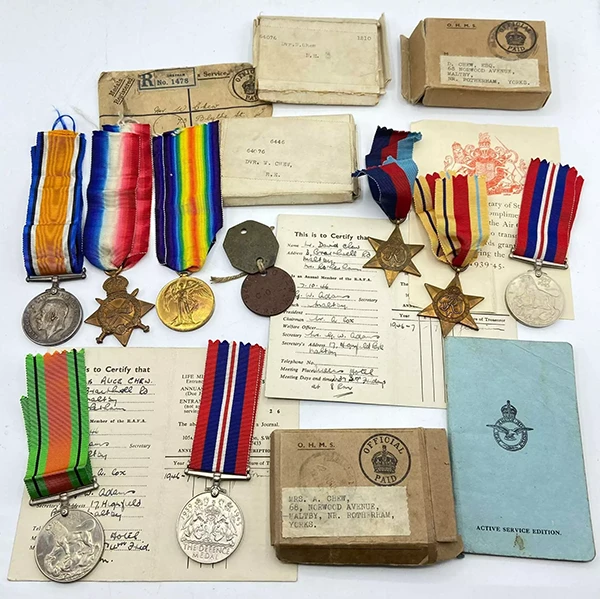
This family group brings together three related service histories across two generations. William Chew served as a driver with the Royal Engineers during the First World War, entering the French theatre in October 1915. His 1914-15 Star, British War Medal and Victory Medal survive with his dog tags, original medal boxes and supporting service-record material.
The group continues through his son David Chew, who served with the Royal Air Force during the Second World War, and David's wife Alice, who served with the Women's Royal Air Force. Their medals remain with RAF association cards, medal entitlement paperwork, postal cartons and David's active-service edition of the Gospel of St John.
In this world, completeness can be relational. The significance lies not simply in the individual medals, but in the survival of a family archive that connects names, service, addresses, documents and objects across two wars.
Authenticity
Genuine parts do not automatically make a genuine object history
Militaria is unusually vulnerable to partial authenticity. A shell can be genuine while its liner is reproduction. A uniform can be period while its desirable insignia were added yesterday. Authentic components can be assembled into a configuration that never historically existed.
Is the underlying piece genuinely of the claimed period and type?
Did liner, fittings, scabbard, insignia or fastenings originate together?
Is the present assembly historically plausible, period-done or a modern put-together?
Factory, depot, field, post-war reuse or collector intervention?
Original finish, reissue paint, camouflage, later repaint or artificial ageing?
Does the claimed veteran, battlefield or unit story have evidence behind it?
Authenticity in militaria often concerns the authenticity of an object's history, not simply the authenticity of its parts.
Counterfeits and reproductions
Reproduction is not the problem. Deception is.
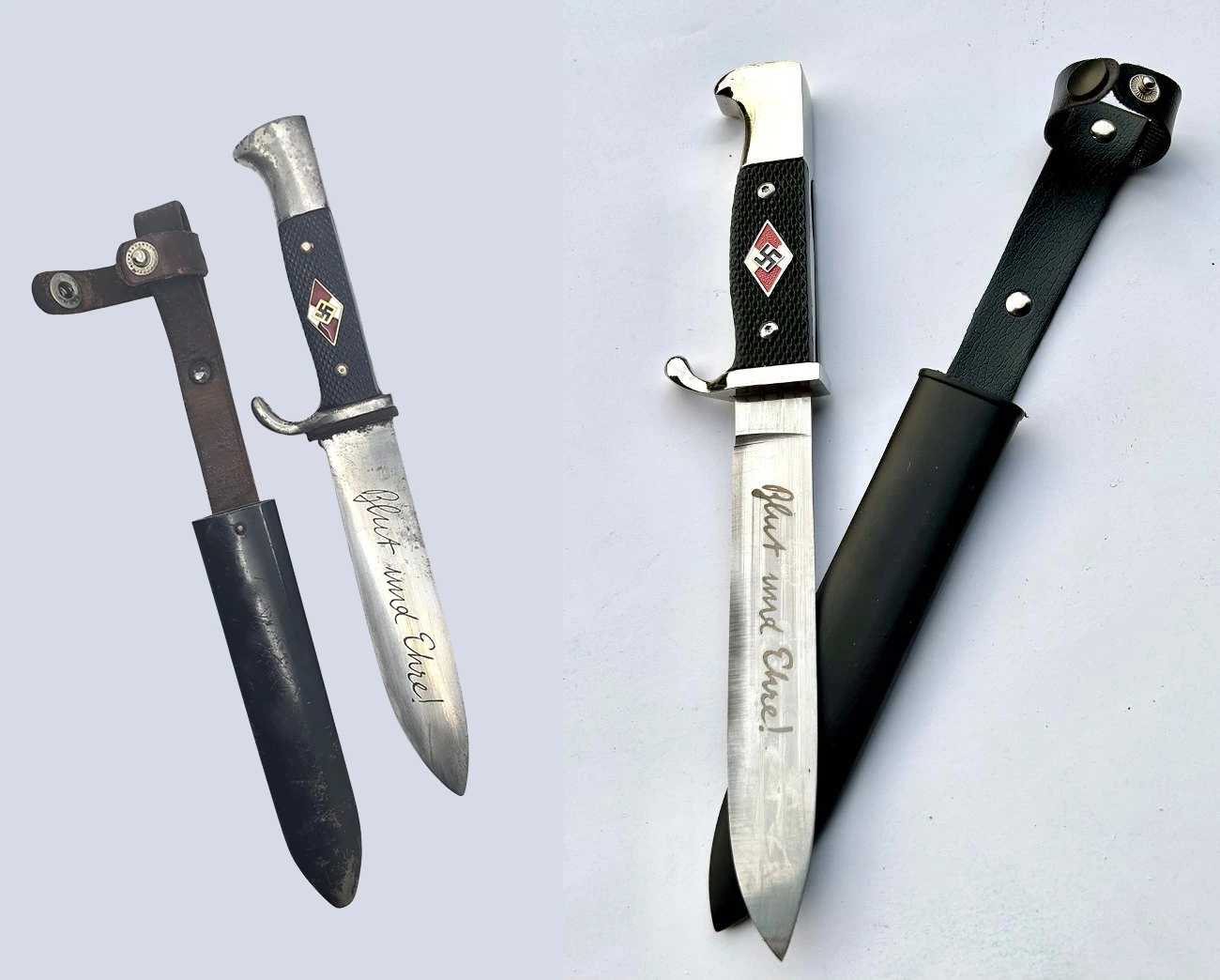
Reproductions serve reenactors, museums, education, film and collectors who do not want to risk fragile originals. The danger begins when age, markings, damage or provenance are manufactured so that a modern object can cross into the historic market.
High-demand items with simple construction and weak documentation are especially exposed. Badges, patches, decals, medals, identity papers and elite-unit material can reward counterfeiters precisely because tiny specialist details carry large premiums.
Today's honestly sold reproduction can become tomorrow's fake once its documentation disappears.
Field modification
Military systems standardise equipment. People make it personal again.
Soldiers cut down equipment, add pockets, improvise straps, repaint helmets, remove insignia, adapt captured material and make local repairs. The resulting object can be less regulation-correct while being more historically revealing.
The hard collector problem is distinguishing a legitimate period alteration from a later attempt to make an ordinary object more dramatic, rare or saleable.
Manufacturing variant, official modification, field modification, post-war reuse or collector intervention?
Battle damage
Drama is not provenance
A bullet hole, impact mark or torn surface can be historically significant, but only if the damage itself belongs to the claimed history. Later damage can be visually dramatic while adding no historical meaning at all.
Specialists look for consistency: surrounding oxidation, material deformation, wear, documentary association and whether the story fits what is physically present.
Something happened to the object.
There is reason to believe what happened belongs to the object's significant historical life.
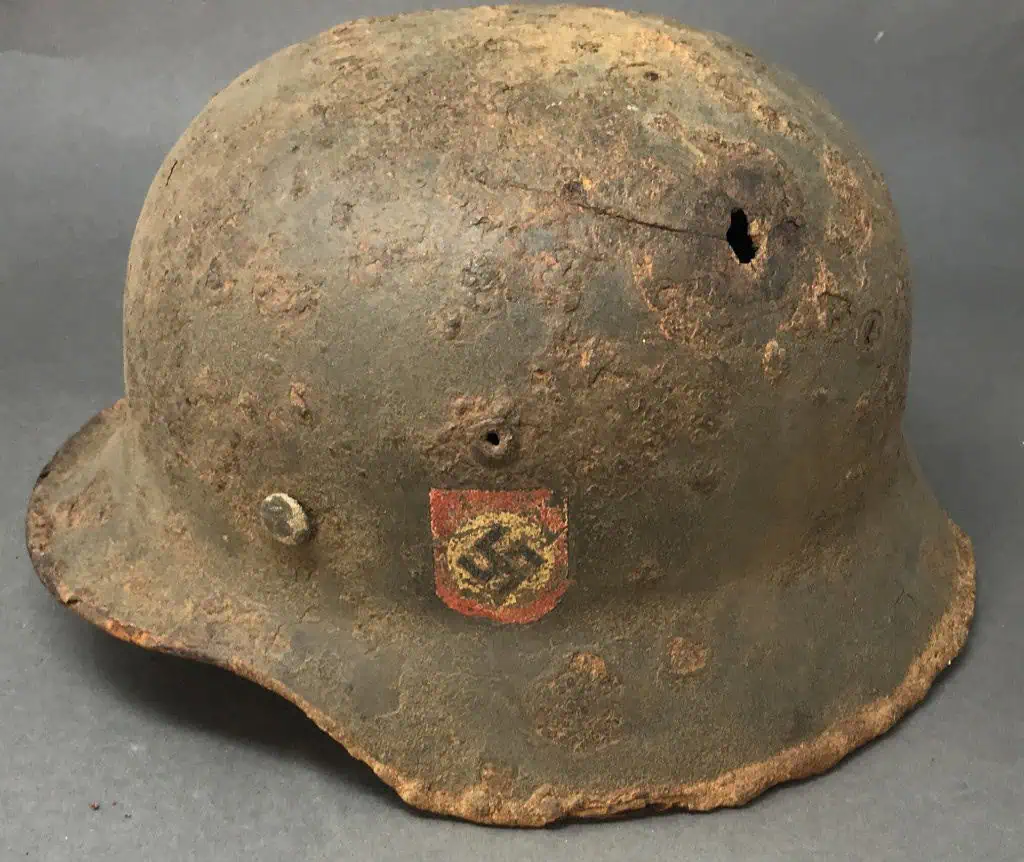
The collector does not merely ask whether damage is old. They ask whether its history can be believed.
Provenance
Provenance can turn a mass-produced object into a singular historical object
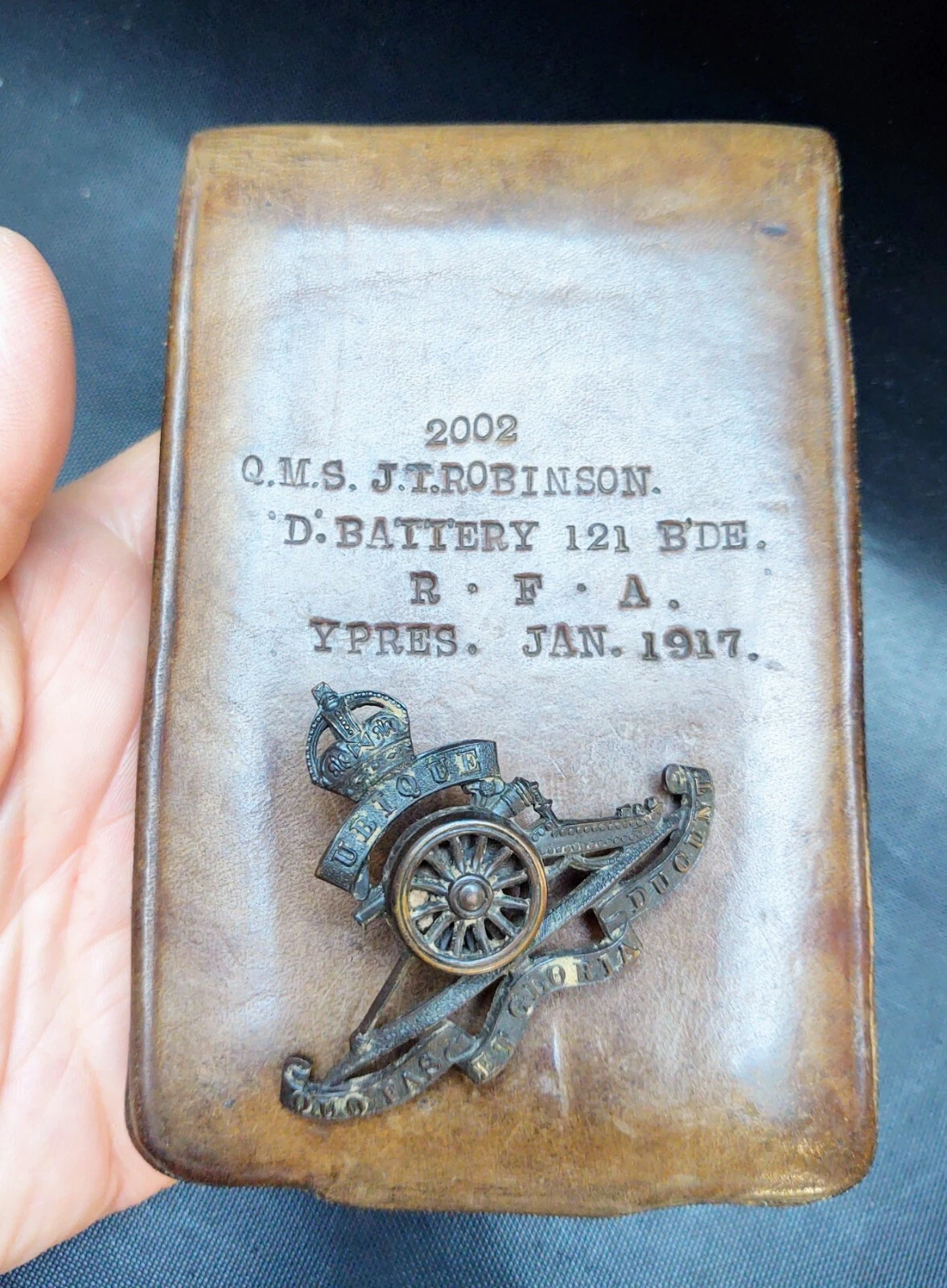
A common helmet with no history is a type example. The same helmet, securely linked to a named person, unit and event, has crossed into biography. Association can outweigh rarity because the object is no longer substitutable in quite the same way.
Generic
"From an old collection."
Veteran
"Acquired from the veteran."
Named
Identity supported by marks or documentation.
Documented
Records, photographs, letters or paperwork connect object and person.
Event-linked
Credible association with a historically significant event.
Militaria is full of compelling stories. The experienced collector asks what evidence accompanies the story.
Biography
Sometimes the least spectacular object has the strongest historical pull
Medals, spoons, notebooks, water bottles, cigarette cases, letters and small personal objects can collapse historical distance precisely because they were carried, used and touched by identifiable people.
A low-value medal can generate weeks of research. A mundane object can become the most meaningful piece in a collection once its person and story are reconstructed.
The object becomes a point of contact with a life, not simply an example of a type.
Restoration
There is no single restoration ethic across this world
The word "restored" can describe radically different collector realities. Context and intended use matter more here than any universal rule.
Corrosion, encrustation and damage may be inseparable from battlefield context. Aggressive cleaning can erase the reason the object matters.
Repainting or replacing fittings can sharply reduce collector appeal because original surfaces and relationships carry evidence.
Replacement, fabrication and mechanical rebuilding may be necessary to preserve function. Untouched-object logic cannot simply be transferred here.
The meaningful question is not "Has it been restored?" but "What kind of object is this, what is being preserved, and what did the intervention change?"
Reenactment and living history
Reproduction can protect originals and generate a different kind of knowledge
Reenactors may own genuine objects for study and display while using accurate replicas for wearing, fighting demonstrations, marching or experimental reconstruction. That creates two legitimate but different forms of authenticity.
Was this object actually made and used in the historical period?
Does the reconstruction accurately reproduce material, form, movement and practical behaviour?
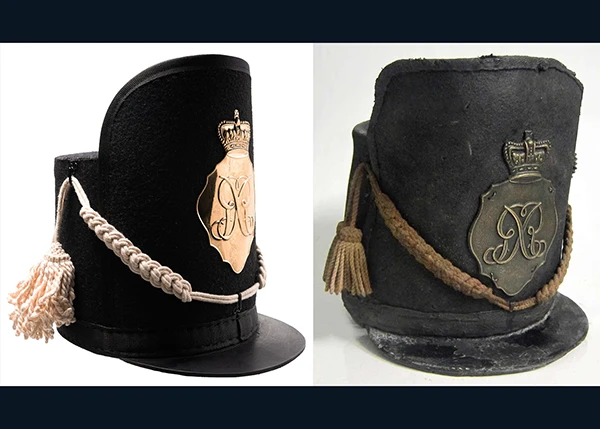
The collector who uses an accurate reconstruction may learn about weight, movement, visibility, discomfort and equipment interaction that a display case cannot reveal.
Preservation
Composite objects punish simple advice
A helmet can combine steel, paint, leather, cloth and adhesive. A uniform can combine wool, cotton, metal, leather and dye. A sword can combine steel, wood, skin, silk, lacquer and copper alloy. A treatment that helps one component can accelerate damage in another.
Do not assume corrosion, patina or old coating is merely dirt to be removed.
Leather treatments, oils and cleaners can affect adjoining metals, textiles and finishes.
Stable environment, careful handling and minimal irreversible intervention often preserve more information than cosmetic improvement.
Rarity versus desirability
Historical visibility can matter more than scarcity
An obscure interwar object may be genuinely rare and still have a thin market. A much more common helmet from a famous conflict may be easier to sell and more expensive because it sits at the centre of a large, visually literate collector culture.
Demand clusters around famous conflicts, recognisable equipment, elite formations, gallantry, dramatic design and named individuals. Then originality, association and condition reorder the examples within that demand.
Few survive.
Collectors recognise it, understand it and compete for it.
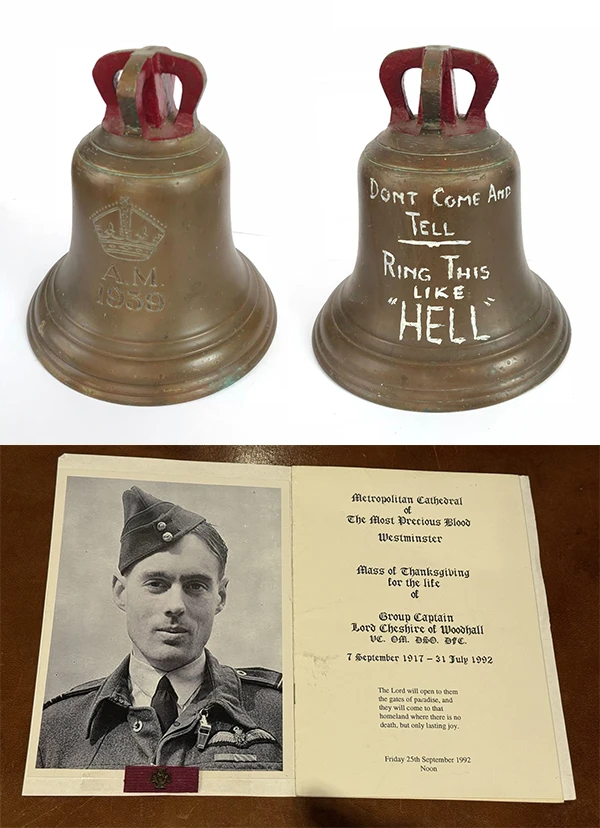
The picture shows in the top section a WWII Air Ministry bronze station bell,f ormerly used at RAF Dishforth when the camp opened in 1936 and then transferred to RAF Topcliffe in 1940. Both camps were part of the then 4 Group, RAF Bomber Command The bottom section is a memorial card for Group Captain Lord Cheshire. Assigned to Bomber Command, Leonard became one of the RAF's youngest commanding officers. His legendary war career included leading No. 617 Squadron - the Dambusters. He became the most highly decorated bomber pilot when awarded the Victoria Cross.
Stories as commodities
Provenance and story are not synonyms
"Picked up at Normandy", "brought home by my grandfather" and "taken from an officer" can be true, family folklore, repeated misunderstanding or sales invention. The more association increases value, the more narrative itself becomes something the market can manufacture.
The stronger question is not "What's the story?" It is "What evidence accompanies the story?"
Insider language
Small distinctions carry large historical consequences
The vocabulary of the field is revealing because it separates physical sameness from historical meaning. Two objects can look nearly identical while occupying completely different collector categories.
Issue / private purchase
Government supplied versus individually acquired.
Factory / field modification
Where and why an alteration occurred.
Matching / mismatched
Whether numbered or associated components originated together.
Period replacement
A replacement made during the object's service life rather than by a later collector.
Reissue
Official later reuse, modification or refurbishment.
Relic / ground-dug
Heavily degraded or excavated material, often carrying legal and archaeological implications.
Put-together
Genuine parts assembled later into a configuration that may or may not be historically valid.
Fantasy piece
An object that looks historical but represents something that never actually existed.
Expertise
The experienced collector learns what normal looks like
Expertise is not simply memorising dates and model names. It is accumulated pattern recognition across thousands of genuine and questionable objects: normal stitching, expected wear, proper combinations of parts, correct fonts, maker marks, oxidation, materials and manufacturing imperfections.
Books, museum collections, dealer catalogues, auction archives, forums, period photographs and handling genuine material all contribute to that visual database.
A helmet.
Shell pattern, maker, size, lot number, finish, repaint, liner, stitching, rivets, chinstrap, markings, decal, field modification and whether the wear is consistent.
Expertise is the transition from recognising the object to recognising its biography.
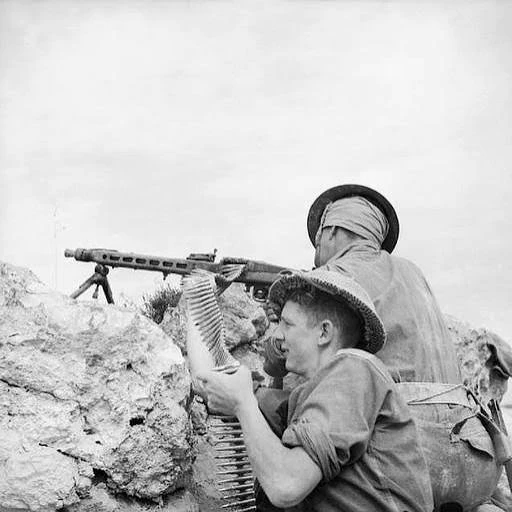
Period photographs
Regulations tell you what should have happened. Photographs show what sometimes did.
Period imagery can resolve disputes over chronology, camouflage, unusual combinations, insignia placement, theatre modifications and unofficial practice. It also protects collectors from mistaking tidy regulation diagrams for lived military reality.
"Incorrect" can sometimes be historically correct.
Difficult provenance
Souvenir, trophy, battlefield pickup and loot are not interchangeable
Conflict moves objects through capture, conquest, occupation, excavation and private souvenir culture. Older descriptions often concentrate on maker and original owner; modern research increasingly asks how the object left that context and entered another collection.
Acquisition history can be part of the object's meaning - and sometimes part of whether it can responsibly be collected at all.
Cultural context
A weapon can cease to be understood if it is interpreted only as a weapon
Arms from African, Indian, Ottoman, Persian, Chinese, Japanese and other traditions can also be ceremonial objects, status markers, diplomatic gifts, artistic works, symbols of rulership or culturally specific expressions of identity.
Martial function may be only one layer of what the object was made to communicate.
Difficult symbolism
Preserving history is not the same as endorsing it
Militaria can preserve evidence of Nazism, fascism, colonial violence, genocide, authoritarian regimes and other histories collectors may have no admiration for at all. Yet the objects also carry meanings beyond the owner's intention, especially when displayed publicly.
Difficult material may need to survive precisely because the history it records is abhorrent.
Stripped of explanation, historical evidence can become iconography, display fetish or misunderstood identity statement.
Worlds within the World
The same broad world contains very different ways of collecting
A collector of excavated Roman arms may depend on archaeological context and legal provenance. A Japanese sword collector may study school, smith, workmanship, polish and formal authentication. A medal collector may spend more time in service records than examining the medal itself. A military vehicle collector may regard substantial mechanical restoration as essential preservation.
Ancient & Archaeological Arms
Find context, legality, excavation history and export history can matter as much as the object itself.
Historic Arms & Armour
Construction, workshop practice, maker marks, composite assemblies and centuries of repair require object-level connoisseurship.
Japanese Arms & Armour
Blade, mountings, school, smith, polish, alteration and formal authentication create a highly developed specialist tradition.
Orders, Decorations & Medals
The object opens into biography - rolls, records, citations, clasps, unit history and whether a group belongs together.
Industrial & Modern Militaria
Stitching, stamps, fonts, rivets, paint, hardware, lot numbers and wear patterns turn authentication into forensic comparison.
Reenactment & Living History
Original objects and accurate reproductions answer different questions: historical survival versus representational accuracy and use.
Military Vehicles
Operational restoration, replacement parts and engineering knowledge create a restoration culture very different from untouched small objects.
Battlefield Relics & Conflict Archaeology
Context, legality, human remains, explosive hazards and disturbance of sites make provenance inseparable from ethics and evidence.
The objects share a martial context. The knowledge required to understand them can be radically different.
Collector judgement
Questions that reveal expertise
The emotional engine
The object collapses historical distance
Much of the attraction is not conventional nostalgia. Nobody remembers a Roman legion or Waterloo. The connection often comes through historical imagination and physical proximity.
This was there. This person carried it. This object survived.
That is why an ordinary personal object with a secure biography can outweigh a visually spectacular piece with no trustworthy history at all.
Collecting Intelligence
The specialist sees relationships the catalogue cannot fully express
This world is exceptionally suited to conversations with collectors, curators, conservators, reenactors, medal researchers, vehicle restorers and subject specialists because expertise often lives in small physical details and accumulated comparison.
Explore Collecting Intelligence →Knowledge Center
Go deeper into the practices behind the object
Condition, provenance, authentication, preservation, restoration, documentation and valuation become much more useful when the specialist conventions surrounding the object are understood first.
Explore the Knowledge Center →Arms, Armour & Militaria as a Collecting World