
Your watch collection. Your way.
Watch Collection Management
Start with the items you own and record the details useful to you.
Keep things simple, or go deeper with makers, brands, models, references, serial numbers, movements, dial variants and service history whenever they matter.
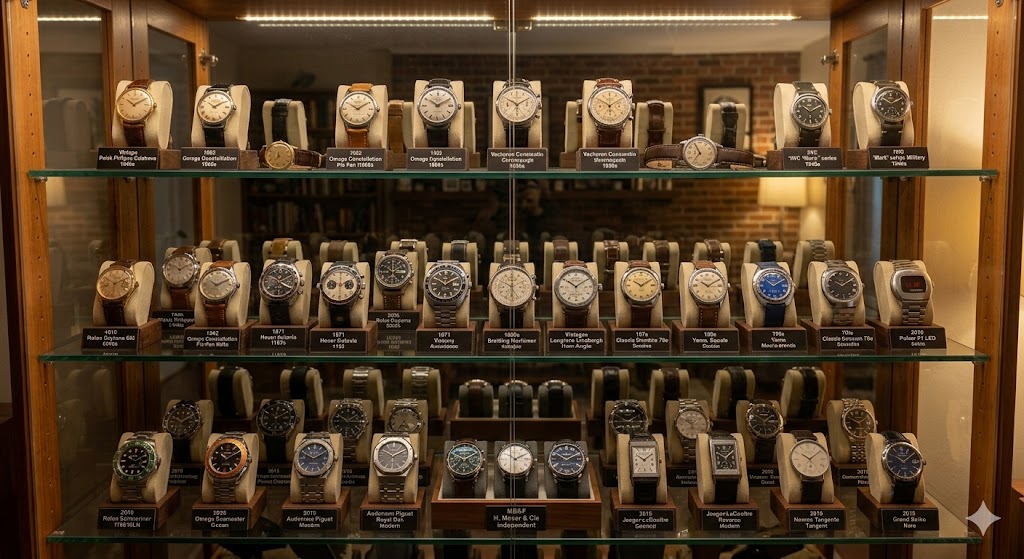
Collect at your own depth
A useful watch record can be simple or highly detailed.
One item might need little more than a name, photograph and condition. Another might deserve detailed records of makers, brands, models, references, serial numbers, movements, dial variants and service history. Both belong in Collectaneum.
Start quickly. Add detail when it earns its place.
Why the collection becomes difficult
Model identity and owned-watch history must remain separate
The same model may exist in different references, case materials, dial configurations, movements, markets and production periods. Later service parts or modifications can further change what survives.
A useful registry therefore needs both technical product knowledge and an item-level record of serials, condition, service, provenance, accessories and documentation.
Maker, brand and reference
Separate commercial brand, manufacturer, model family, exact reference and production period.
Movement and configuration
Record calibre, movement number, complications, case material, dial, hands, bezel, bracelet and clasp.
Serial and markings
Preserve case, movement, bracelet and other identifiers with photographs and transcription.
Originality and service parts
Document replacements, refinishing, reluming, service dials, changed hands and other interventions.
Box, papers and accessories
Connect warranty papers, certificates, manuals, tags, receipts and original packaging to the watch.
Service and value history
Keep dated service work, condition changes, insurance values and market evidence over time.
From model reference to owned watch
Build the record in connected layers
Shared information can describe a recognised reference and configuration, while serial numbers, condition, servicing, provenance and accessories remain specific to the watch in your collection.
Identify the watch
Record maker, brand, model, reference, production period, case material, dial configuration and intended market.
Describe the mechanism
Capture calibre, movement type, complications, movement number and technical notes.
Record your example
Preserve serials, case and bracelet details, condition, originality, service work, accessories and storage location.
Attach the evidence
Connect photographs, receipts, warranty papers, service invoices, provenance, research and valuations.
A record in practice
A reference number does not describe the whole watch
The shared record may identify a model family, exact reference, case material, movement calibre and known dial or bracelet configurations.
The owned-watch record then captures serial numbers, dial and hand condition, polishing, replacement parts, bracelet stretch, service history, timekeeping observations, box and papers, acquisition source, provenance and current location.
Another watch of the same reference can reuse reliable technical knowledge while retaining a completely separate condition and service history.
Owned-item evidence
Service history is part of object history
Invoices, replaced-part notes, pressure tests and watchmaker observations can explain both present condition and later originality questions. They should remain attached to the watch they concern.
Important collecting distinctions
Details that should not be collapsed into one label
Watch records are clearer when commercial identity, technical configuration and the present state of the individual watch are not treated as one field.
Model or reference
A model family may include multiple references, materials, movements and market variants.
Original or period-correct
A period-correct component may be appropriate for the era without being original to that particular watch.
Serviced or restored
Routine mechanical servicing, cosmetic refinishing and replacement of visible components are different interventions.
Asking price or supported value
Dealer listings, auction results, insurance values and realised prices answer different valuation questions.
Technical records change over time
Later servicing should enrich the record rather than overwrite it
A watch may acquire a new crystal, crown, hands, dial, bezel, movement component or bracelet during service. Those changes can affect function, appearance, originality and value.
Collectaneum preserves dated interventions and supporting invoices so the current configuration can be understood alongside its earlier history.
Learn more when you want to
Research the judgement, then preserve the evidence
The Knowledge Center supports documentation, authentication, condition assessment, valuation and insurance decisions. The registry keeps service records, photographs and conclusions connected to the owned watch.
Collectaneum does not authenticate, grade or value an object for you. It keeps conclusions, uncertainty and supporting material connected to the exact owned item so the record remains reviewable.
Your watch collection. Your way.
Start recording your watch collection
Create connected records for references and owned watches while preserving serials, movements, service history, condition, provenance, accessories, documents and valuations.
Start with the essentials and add more whenever it matters. The depth is there when you want it.