
Your Scalextric collection. Your way.
Scalextric Collection Management
Start with the items you own and record the details useful to you.
Keep things simple, or go deeper with cars, sets, catalogue references, production variants, track, accessories, condition and originality whenever they matter.
Collect at your own depth
A useful Scalextric record can be simple or highly detailed.
One item might need little more than a name, photograph and condition. Another might deserve detailed records of cars, sets, catalogue references, production variants, track, accessories, condition and originality. Both belong in Collectaneum.
Start quickly. Add detail when it earns its place.
Why the collection becomes difficult
Racing and preserving pull the same object in different directions
Tyres, braids, gears, motors and guide blades wear through normal use, while crashes affect mirrors, spoilers, paint and decals. Servicing may improve the car while also changing its original state.
A useful registry therefore needs to record performance, physical condition, originality and intervention separately rather than forcing them into one grade.
Car, reference and production state
Separate the vehicle subject, Scalextric catalogue reference, mould, chassis, production period and recognised factory variation.
Racing condition and collector condition
Record how the car performs separately from body, paint, decals, windows, mirrors, tyres, braids and packaging condition.
Originality and consumables
Distinguish original components from replaced tyres, braids, guide blades, gears, mirrors, spoilers, decals and other service or restoration parts.
Sets and trackside systems
Track cars, controllers, track, barriers, buildings, figures, instructions, inserts and power equipment as connected set components.
Regional and factory variants
Preserve UK, Spanish, French and other production differences in liveries, decoration, packaging, country marks and component specification.
Analogue, digital and modification
Document digital conversion, motor changes, tuning, rewiring and other interventions that improve use while altering original configuration.
From catalogue reference to owned car
Build the record in connected layers
Shared catalogue knowledge can describe a recognised car, set or production state while running history, replacement parts, wear, restoration and provenance remain specific to your individual example.
Identify the car or set
Record catalogue number, model, real vehicle, race or livery, production period, country, scale and set or product family.
Distinguish the variation
Capture mould, chassis, motor, wheels, tyres, braid arrangement, decoration method, race number, packaging and known regional differences.
Describe your example
Preserve running condition, body wear, missing details, replacement parts, servicing, restoration, box condition and storage or display status.
Attach the evidence
Connect photographs, receipts, catalogues, service notes, provenance, variant research and valuations to the exact owned item.
A record in practice
A red racing car is not enough identification
The shared record may identify the catalogue number, real vehicle, livery, race number, production period, mould, chassis, motor, country and known packaging or decoration variants.
The owned-item record then captures tyre and braid condition, missing mirrors or spoilers, chassis swaps, motor servicing, digital conversion, replacement decals, body wear, box condition, acquisition source, photographs and valuations.
Two cars that look almost identical from above can therefore share catalogue knowledge while retaining very different production and ownership histories.
Owned-item evidence
The underside often identifies the real variant
Country marks, chassis references, motor type, wheel design, gearing, braid arrangement, screw type and magnet configuration can distinguish production states that the body alone does not reveal.
Important collecting distinctions
Details that should not be collapsed into one label
Scalextric records are clearer when performance, originality, packaging, production state and desirability remain separate questions.
Race-ready or factory-original
A car may run better after new tyres, braids or mechanical tuning while becoming less original as a collectible example.
Boxed or correctly boxed
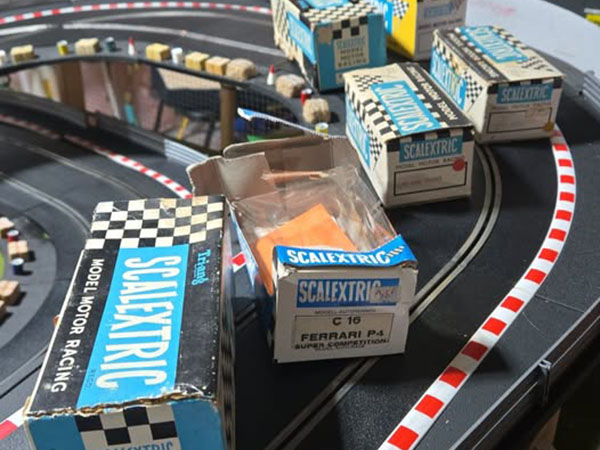
A box with the right catalogue number may still be wrong for the production period, country, insert or exact release.
Production variant or later alteration
Missing decoration, unusual colours or changed components may reflect factory production, repair, parts swapping or customisation.
Rare or desirable
Scarcity alone does not determine value; famous cars, drivers, liveries, iconic sets and childhood recognition can drive much stronger demand.
Condition extends beyond the car body
Decoration, mechanism, consumables and packaging can age differently
Paint and tampo printing may remain excellent while tyres harden, braids deteriorate or motors become intermittent. Boxes, inserts, controllers, track and accessories may also have completely different condition histories.
Keeping those observations separate creates a more useful record than one overall grade, particularly for complete vintage sets and cars that have been serviced or raced.
Learn more when you want to
Research the variant, then preserve the evidence
The Knowledge Center supports documentation, authentication, condition, restoration and valuation decisions. The registry keeps photographs, service history and conclusions connected to the exact owned car or set.
Collectaneum does not authenticate, grade or value an object for you. It keeps conclusions and supporting material connected to the item so the record remains reviewable as production or variant research develops.
Your Scalextric collection. Your way.
Start recording your Scalextric collection
Create connected records for cars, sets, catalogue references, liveries, production states, track and accessories while preserving running condition, originality, restoration, photographs and valuations for each owned item.
Start with the essentials and add more whenever it matters. The depth is there when you want it.