
Your construction & engineering toy collection. Your way.
Construction & Engineering Toy Collection Management
Start with the items you own and record the details useful to you.
Keep things simple, or go deeper with makers, systems, sets, production eras, component inventories, variants, completeness and condition whenever they matter.
Collect at your own depth
A useful construction and engineering toy record can be simple or highly detailed.
One item might need little more than a name, photograph and condition. Another might deserve detailed records of makers, systems, sets, production eras, component inventories, variants, completeness and condition. Both belong in Collectaneum.
Start quickly. Add detail when it earns its place.
Why the collection becomes difficult
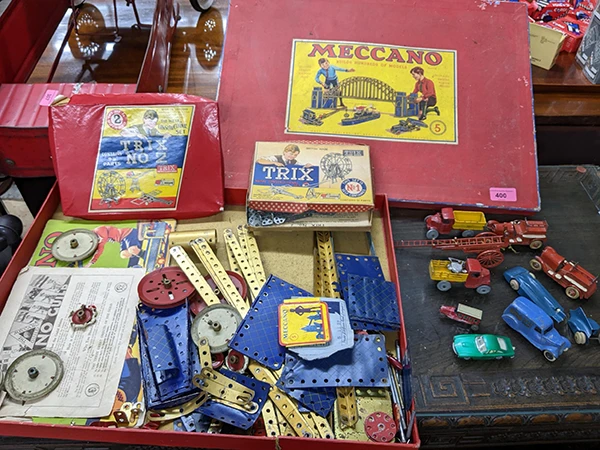
A set is only one expression of a larger construction system
Components were designed to be removed, mixed, reused and expanded. Over time, parts migrate between sets, manuals disappear, boxes are discarded and later replacements enter otherwise original collections.
A useful registry therefore needs to preserve both the intended factory configuration and the present reality of the owned set or working parts collection.
System, maker and set
Separate the construction system, maker, numbered outfit or set, production era and regional issue.
Component inventories
Track beams, plates, gears, wheels, fasteners, motors, architectural parts and other components against known set inventories.
Period-correct variants
Preserve colour, finish, material, stamping, mould, fastener and packaging differences that may identify a particular production generation.
Box, manuals and inserts
Keep trays, tins, instruction books, parts lists, catalogues and packing material connected to the set they document.
Originality and reconstruction
Distinguish retained original contents from period-correct replacements, later genuine parts, reproductions and reconstructed outfits.
Condition and functionality
Record paint loss, corrosion, warping, cracks, damaged threads, motor operation and box condition as separate observations.
From construction system to owned set
Build the record in connected layers
Shared catalogue knowledge can describe a recognised set, production era and expected inventory, while missing components, substitutions, repairs, condition and provenance remain specific to your owned example.
Identify the system
Record maker, construction system, set or outfit number, release period, country or factory, catalogue reference and intended market.
Define the set variation
Capture production era, colour scheme, packaging style, manual edition, component specification, conversion set relationships and recognised variants.
Describe your example
Preserve verified component count, missing parts, original and replacement components, mechanical condition, repairs, restoration and storage arrangement.
Attach the evidence
Connect photographs, inventories, manuals, catalogues, receipts, provenance, research notes and valuations to the exact owned set or model.
A record in practice
A box labelled with a set number does not prove what is inside
The shared product record may identify the maker, outfit or set number, production era, packaging style, manual edition and expected quantities of major components.
The owned-item record then captures the actual inventory, missing pieces, period-correct and later replacements, repainting, corrosion, bent parts, motor condition, box state, instructions, acquisition source, photographs and valuations.
Two sets that appear identical on a shelf can therefore share catalogue knowledge while retaining very different component and originality histories.
Owned-item evidence
Completeness often has to be inventoried
Large outfits may contain hundreds or thousands of parts. Recording the actual component count, substitutions and missing pieces is more reliable than describing a set as simply "complete" or "incomplete".
Important collecting distinctions
Details that should not be collapsed into one label
Construction-toy records are clearer when set identity, component authenticity, functionality and historical originality remain separate questions.
Set complete or period complete
A set may contain the correct number of parts while still including later or incorrect production-generation components.
Original or reconstructed
An outfit assembled later from correct vintage parts can be complete and authentic in component terms without being an untouched original set.
Preserved or functional
A pristine unused set may preserve historical state, while a repaired or mixed collection may better fulfil the system's intended purpose as building material.
Component or collection identity
Parts can migrate between sets for decades, so a genuine component may retain system identity while losing any reliable link to its original outfit.
Condition has several independent axes
Components, mechanisms and packaging may age very differently
Metal parts may show paint loss, corrosion, bent strips or damaged threads; plastic parts may fade, yellow, crack or warp; motors and gears may look complete while no longer working.
Box condition, manual condition, mechanical function and component completeness should therefore remain separately reviewable rather than being reduced to one overall grade.
Learn more when you want to
Research the set, then preserve the evidence
The Knowledge Center supports documentation, authentication, condition, restoration and valuation decisions. The registry keeps inventories, photographs and conclusions connected to the exact set, model or parts collection.
Collectaneum does not authenticate, grade or value an object for you. It keeps conclusions and supporting material connected to the owned item so the record remains reviewable as component and production research develops.
Your construction & engineering toy collection. Your way.
Start recording your construction & engineering toy collection
Create connected records for makers, systems, sets, production eras, manuals and component inventories while preserving completeness, functionality, originality, restoration, photographs and valuations for each owned example.
Start with the essentials and add more whenever it matters. The depth is there when you want it.