
Your coin collection. Your way.
Coin Collection Management
Start with the items you own and record the details useful to you.
Keep things simple, or go deeper with countries, denominations, dates, mints, mint marks, varieties, errors and grades whenever they matter.
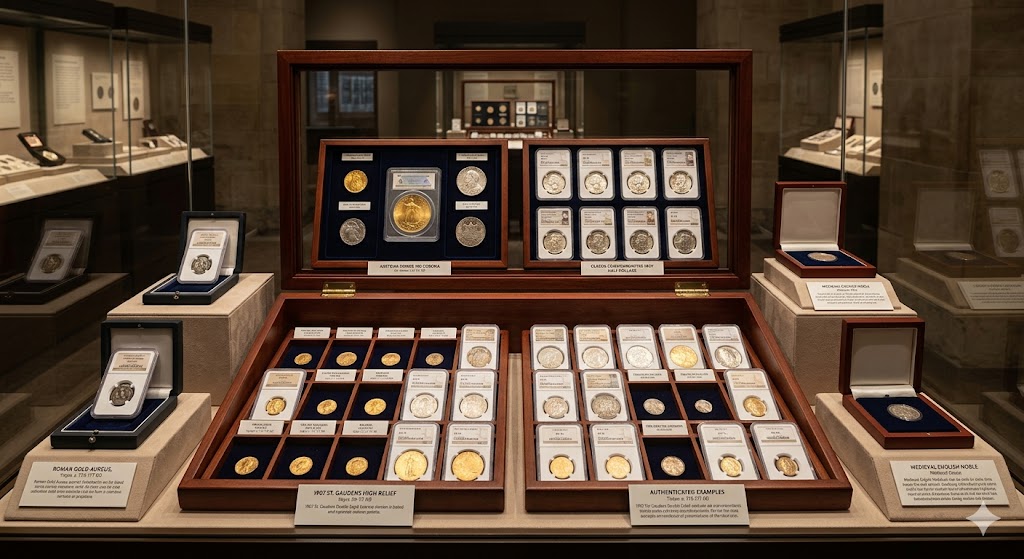
Collect at your own depth
A useful coin record can be simple or highly detailed.
One item might need little more than a name, photograph and condition. Another might deserve detailed records of countries, denominations, dates, mints, mint marks, varieties, errors and grades. Both belong in Collectaneum.
Start quickly. Add detail when it earns its place.
Why the collection becomes difficult
Small physical differences can carry major collecting meaning
Numismatic identification is often cumulative. A reliable description may depend on the issuing authority, denomination, date, mint, mint mark, die characteristics, metal, weight and known variety.
The collection also has an owned-item history: grade, certification, surface condition, provenance, acquisition source and changes in value belong to the individual coin rather than the type in general.
Attribution and variety
Keep denomination, date, mint, mint mark, die variety and error characteristics distinct rather than hiding them in one title.
Grade and surfaces
Record wear, strike, lustre, toning, cleaning, damage and other observations separately from a single grade.
Certification
Connect grading service, grade, label details, certification number and slab photographs to the owned coin.
Sets and runs
Group coins by series, reign, denomination, type set, date run or collecting objective without duplicating records.
Provenance and acquisition
Preserve previous ownership, auction appearances, dealer information, receipts and collection pedigrees.
Market evidence over time
Keep dated valuations and comparable sales without presenting one figure as permanent or universal.
From coin type to owned example
Build the record in connected layers
Shared numismatic knowledge can describe a recognised type or variety, while certification, condition, provenance and documents remain specific to the coin in your collection.
Identify the coin
Record country or authority, denomination, date, mint, mint mark, ruler or issuing period and principal type.
Distinguish the variety
Capture die variety, error, composition, dimensions, weight, edge, reference numbers and other attribution evidence.
Describe your example
Preserve grade, certification, surface condition, toning, damage, cleaning, holder details and storage location.
Attach the evidence
Connect photographs, receipts, auction records, provenance, research notes, certificates and dated valuations.
A record in practice
A date and denomination are only the beginning
The shared record may identify the issuing authority, denomination, date, mint, composition, type and recognised variety. Reference numbers and diagnostic features can explain how that attribution was reached.
The owned-item record then captures grade, certification service and number, slab or holder, toning, surface marks, acquisition source, purchase price, provenance, photographs, location and valuation history.
A second coin of the same type can reuse reliable identification while retaining its own condition, certification and ownership evidence.
Owned-item evidence
The evidence should travel with the attribution
Close photographs, weight, dimensions, edge detail, slab labels and specialist references can support identification. Keeping them together makes future review possible.
Important collecting distinctions
Details that should not be collapsed into one label
Coin records become more reliable when attribution, condition and commercial assessment are recorded as related but separate judgements.
Type or variety
A coin can share a broad type while a die pairing, mint mark or recognised variety distinguishes the exact attribution.
Wear or surface problem
Circulation wear, weak strike, cleaning, corrosion, scratches and toning are different observations and should not be reduced to one condition label.
Raw or certified
Certification adds a third-party opinion and identifier; it does not replace photographs, provenance or the collector’s own record.
Rarity or market value
A scarce variety is not automatically valuable in every grade, and a market figure should remain dated and evidence-based.
Beyond the catalogue number
A numismatic record should preserve how the attribution was reached
Reference catalogues and grading labels are useful, but the collector may also need to preserve diagnostic notes, measurements, edge details, photographs and conflicting opinions.
Collectaneum provides room for structured fields and qualified narrative so uncertainty or later research can be added without erasing the earlier record.
Learn more when you want to
Research the judgement, then preserve the evidence
The Knowledge Center provides guidance on grading, authentication, provenance, photography and valuation. The registry preserves the observations and supporting evidence produced by those processes.
Collectaneum does not authenticate, grade or value an object for you. It keeps conclusions, uncertainty and supporting material connected to the exact owned item so the record remains reviewable.
Your coin collection. Your way.
Start recording your coin collection
Create connected records for types, varieties and owned coins while keeping grades, certification, provenance, photographs, acquisition history and valuations attached to the correct example.
Start with the essentials and add more whenever it matters. The depth is there when you want it.