
Your action figure collection. Your way.
Action Figure Collection Management
Start with the items you own and record the details useful to you.
Keep things simple, or go deeper with franchises, manufacturers, product lines, scales, waves, variants, packaging and accessories whenever they matter.
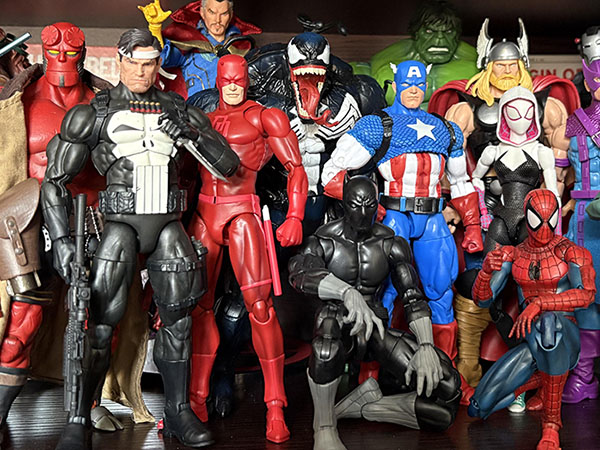
Collect at your own depth
A useful action figure record can be simple or highly detailed.
One item might need little more than a name, photograph and condition. Another might deserve detailed records of franchises, manufacturers, product lines, scales, waves, variants, packaging and accessories. Both belong in Collectaneum.
Start quickly. Add detail when it earns its place.
Why the collection becomes difficult
The same character can exist in dozens of genuinely different releases
A figure may be reissued across manufacturers, scales, waves, sculpts, costumes, paint applications, regional markets and exclusive releases. Packaging may change even when the figure itself does not.
A useful registry therefore needs to record both the catalogue identity of the release and the physical state of the owned example.
Franchise and product line
Separate the character or franchise from the manufacturer, product line, series, wave and release period.
Scale and format
Record scale, body style and articulation system because different formats can represent distinct collecting traditions.
Variants and exclusives
Preserve paint, mould, accessory, packaging, regional, retailer, convention and production differences without treating every change as identical.
Loose, carded or boxed
Keep packaging state separate from figure condition so loose, MOC, MIB and sealed examples remain meaningfully distinct.
Accessories and completeness
Track weapons, clothing, alternate parts, inserts and other original components that may determine whether an example is truly complete.
Originality and intervention
Document replacement parts, repainting, repairs, recarding, resealing, customisation and reproduction components at owned-item level.
From product line to owned figure
Build the record in connected layers
Shared catalogue knowledge can describe a recognised figure release while condition, completeness, packaging, grading, intervention and provenance remain specific to the example you actually own.
Identify the figure
Record franchise, character, manufacturer, product line, series, wave, release year, scale and catalogue reference.
Distinguish the release
Capture packaging style, assortment, exclusive status, region and recognised paint, mould, accessory or production variants.
Describe your example
Preserve loose, carded or boxed state, accessories, completeness, condition, grading, repairs, restoration, reproduction parts and storage location.
Attach the evidence
Connect photographs, receipts, grading records, provenance, research notes and valuations to the exact owned figure they support.
A record in practice
A loose figure and a sealed figure are not the same collecting record
The shared product record may identify the character, manufacturer, product line, scale, wave, release year and recognised variants.
The owned-item record then captures whether your example is loose, carded, boxed or graded; which accessories remain; packaging condition; paint wear; joint condition; repairs; reproduction parts; acquisition source; photographs and valuations.
Two collectors can therefore own the same release while preserving completely different completeness, condition and originality histories.
Owned-item evidence
Accessories can carry their own authenticity questions
Small weapons, capes, alternate parts and inserts may look interchangeable while differing by mould, tooling or production source. Record what is present and keep originality or reproduction evidence attached to the exact figure.
Important collecting distinctions
Details that should not be collapsed into one label
Action figure records become more reliable when identity, completeness, originality and scarcity are treated as different questions.
Character or release
The same character may appear across many manufacturers, product lines, scales, sculpts, costumes and generations.
Complete or original
A figure can appear complete with replacement accessories while no longer being fully original.
Variant or normal production difference
Not every paint or mould difference deserves separate catalogue status; recognised collector distinctions should remain evidence-based.
Scarcity or engineered exclusivity
Vintage rarity may result from survival and distribution, while modern scarcity is often created through exclusives, timed releases or limited production.
Condition has more than one surface
Figure, accessories and packaging may age differently
Paint rub, yellowing, loose joints, cracked parts, fabric wear and missing accessories affect the figure itself. Card creases, bubble yellowing, dents, cracks, edge wear and sticker damage affect packaging independently.
Keeping those observations separate creates a more useful record than a single overall condition label, particularly for carded and boxed examples.
Learn more when you want to
Research the judgement, then preserve the evidence
The Knowledge Center supports documentation, authentication, condition, restoration and valuation decisions. The registry keeps the resulting observations, photographs and evidence connected to the owned figure.
Collectaneum does not authenticate, grade or value an object for you. It keeps conclusions and supporting material connected to the exact item so the record remains reviewable.
Your action figure collection. Your way.
Start recording your action figure collection
Create connected records for characters, manufacturers, product lines, scales, waves and variants while preserving packaging, accessories, completeness, condition, grading, originality, photographs and valuations for each owned figure.
Start with the essentials and add more whenever it matters. The depth is there when you want it.